

5 Mukhi Rudraksha Benefits: What Panchmukhi Actually Does & Who Should Wear It
Certified & Energised
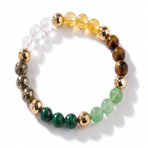
GemSense Dhan Yog Crystal Bracelet for Wealth & Financial Success
The reader-favourite place to start — five wealth stones on one wrist, SGL certificate in the box.
₹ 699₹ 1,399TL;DR: In Vedic tradition, the 5 mukhi rudraksha (Panchmukhi) embodies the Kalagni Rudra form of Lord Shiva and is governed by Jupiter (Brihaspati). Wearers believe it brings calm focus, self-discipline, and steady spiritual growth, and it is considered the one rudraksha everyone can wear — men, women, students, and working professionals alike. Before buying, insist on an SGL lab certificate confirming the bead is genuine, with five natural internal seed chambers.
Walk into any temple town in India — Haridwar, Kashi, Rameswaram — and the bead you will see most often around the necks of priests, pilgrims, and everyday devotees is the 5 mukhi rudraksha. It is the most common rudraksha on earth, and in the Puranas that is treated not as a weakness but as a blessing: the bead meant for everyone. This guide explains the traditional 5 mukhi rudraksha benefits, the sacred meaning behind the five faces, exactly how to wear one for the first time, and — because the market is flooded with fakes — how an SGL certificate proves your bead is genuine.
What Does 5 Mukhi Rudraksha Mean? The Sacred Story of Panchmukhi
A 5 mukhi rudraksha is the seed of the Elaeocarpus ganitrus tree bearing five natural lines (mukhis) that run from crown to base. In Vedic tradition it embodies Kalagni Rudra, a fierce yet purifying form of Lord Shiva, is ruled by the planet Jupiter (Brihaspati), and is energised with the mantra "Om Hreem Namah".
The Shiva Purana and Padma Purana describe rudraksha beads as the crystallised tears of Shiva, shed after deep meditation on the welfare of all beings. Each mukhi count carries its own presiding deity, and the five-faced bead belongs to Kalagni Rudra — the form of Shiva believed to burn away accumulated negativity the way fire burns away impurity in metal. Its five faces are also read as the five elements (earth, water, fire, air, space) and the five breaths (pranas) of yogic philosophy, which is why the bead is associated with balance rather than any single, narrow blessing.
Just as importantly, tradition classifies the Panchmukhi as a sattvic bead — pure, gentle, and harmonising. Some rarer mukhis come with strict rules about who may wear them and when. The 5 mukhi carries no such restrictions in mainstream tradition, which is precisely why gurus commonly recommend it as the first rudraksha, and why a 5 mukhi rudraksha mala is the standard mala used for japa across India.
What Are the Benefits of Wearing 5 Mukhi Rudraksha?
The traditional 5 mukhi rudraksha benefits centre on mental calm, focus, and discipline. In Vedic belief, the bead pacifies a restless mind, strengthens Jupiter in the wearer's chart, supports honest speech and clear judgement, and deepens meditation. Wearers treat it as a daily anchor for steadiness rather than a magic object.
It helps to be honest about what "benefits" means here. Rudraksha is a devotional tradition, not a laboratory-tested therapy — the value wearers report flows from faith, ritual, and the psychology of a daily anchor. Within that frame, the classical texts and living tradition attribute a consistent set of gifts to the five-faced bead:
- Mental calm and focus: wearers use the bead as a touchstone during study, work, and meditation — a physical reminder to return to the breath and the task.
- Discipline and routine: the daily ritual of wearing, chanting, and caring for the bead builds a structure that many people find genuinely steadying.
- Jupiter's blessings: in Vedic astrology, Brihaspati governs wisdom, teachers, and learning; the Panchmukhi is worn to invite those qualities.
- Purification of speech and thought: Kalagni Rudra is believed to burn away negative patterns, so the bead is worn with the intention of honesty and restraint.
- Support for japa and meditation: a 108-bead Panchmukhi mala is the classical tool for mantra repetition.
You will also hear older, folk-level claims — that the five-faced bead cools the body or steadies blood pressure. Treat these strictly as traditional beliefs handed down through generations, not medical facts. A rudraksha is never a reason to skip a doctor's visit, stop a prescription, or delay treatment. Its honest value lies in intention, ritual, and calm — which is exactly how the tradition itself frames it.
5 Faced Rudraksha Benefits for Students and Working Professionals
Ask why the 5 faced rudraksha benefits students so specifically, and the answer again runs through Jupiter. Brihaspati is the guru of the gods — the presiding force of learning, memory, and mentorship in Vedic astrology. Students preparing for board exams, JEE, NEET, or UPSC often wear a Panchmukhi with the intention of steady concentration and respect for their teachers. Working professionals wear it for composure in high-pressure environments: the bead sits under a shirt collar unnoticed in any office, and many wearers describe touching it before a difficult meeting the way others take a deep breath. None of this is supernatural on its face — it is the quiet power of a consistent, meaningful ritual, which is exactly what the tradition prescribes.
Who Should Wear 5 Mukhi Rudraksha?
Anyone can wear a 5 mukhi rudraksha. Tradition places no restriction of gender, age, caste, profession, or even religion on the Panchmukhi — it is considered the most universally wearable, sattvic bead of all. Men, women, children, students, homemakers, and office-goers all wear it, which is why gurus recommend it as everyone's first rudraksha.
The question "who can wear 5 mukhi rudraksha" is one of the most searched rudraksha queries in India, and the traditional answer is refreshingly simple: everyone. Where certain mukhis come with cautions — some texts advise specific beads only for particular life stages or spiritual practices — the five-faced bead is the open door of the rudraksha world. Specific groups who traditionally favour it include:
- First-time wearers who want to begin a rudraksha practice without complex rules.
- Students seeking focus, memory, and the blessing of Brihaspati for their studies.
- Professionals in stressful roles who want a daily anchor for composure.
- Meditators and japa practitioners, for whom the Panchmukhi mala is the classical instrument.
- Those with a weak Jupiter in their birth chart, as advised by an astrologer.
A few common-sense courtesies apply from tradition rather than prohibition: many wearers remove the bead before entering places they consider ritually impure, and some prefer not to wear it during periods of mourning. These are customs, not rules, and practice varies by family and region. If you want a single genuine bead to start with, a certified 5 mukhi rudraksha (Panchmukhi) is the traditional first step.
How Do You Wear 5 Mukhi Rudraksha for the First Time?
Tradition says to begin on a Monday (Shiva's day) or Thursday (Jupiter's day). Bathe, sit facing east, place the bead on a clean cloth before a Shiva image, sprinkle it with clean water or raw milk, chant "Om Hreem Namah" 108 times, then wear it on a thread or chain touching the skin.
Here is the simple first-wearing ritual most Indian households follow — no priest required, though you may certainly visit a temple if that feels right:
- Choose the day: Monday for Shiva, Thursday for Brihaspati. Early morning, after bathing, is considered ideal.
- Purify the bead: rinse it gently with clean water; some families touch it with raw milk or a little Gangajal, then pat it dry.
- Energise with the mantra: sit quietly, hold the bead, and chant "Om Hreem Namah" — traditionally 108 times. "Om Namah Shivaya" is an accepted alternative.
- Set an intention: tradition treats this as sankalpa — state silently what you are wearing the bead for: focus, calm, devotion, discipline.
- Wear it: on a red or yellow thread, or a silver or gold chain, so the bead touches the skin at the chest or sits at the throat.
After the first wearing, how to wear 5 mukhi rudraksha day to day is easy: most people simply keep it on. Many wearers remove it before bathing with soap (to protect the bead, not for ritual reasons), and re-wear it after. There is no traditional requirement to remove the Panchmukhi while eating, working, or sleeping, though personal practice varies. What matters most in the tradition is regularity and respect — the bead is treated as a living presence of Shiva, not jewellery.
5 Mukhi vs 6 Mukhi vs 7 Mukhi: Which Rudraksha Should You Choose?
Choose the 5 mukhi for all-round calm, focus, and spiritual grounding — it suits everyone. The 6 mukhi, linked to Kartikeya and Mars, is traditionally chosen for willpower and confidence. The 7 mukhi, linked to Goddess Mahalakshmi and Venus, is worn with the intention of abundance and relief from struggle.
| Mukhi | Deity | Planet | Best for |
|---|---|---|---|
| 5 Mukhi (Panchmukhi) | Kalagni Rudra (Shiva) | Jupiter (Brihaspati) | Calm, focus, discipline, meditation — the universal first bead for students, professionals, and devotees |
| 6 Mukhi | Kartikeya | Mars (Mangal) | Willpower, courage, confidence, and grounded action — traditionally favoured by those facing competition or conflict |
| 7 Mukhi | Mahalakshmi | Venus (Shukra) | Abundance, prosperity, and relief from prolonged hardship — worn with the intention of easing financial struggle |
A practical way to decide: if this is your first rudraksha, or you cannot articulate a single sharp intention, the tradition's answer is always the Panchmukhi — it is sattvic, unrestricted, and harmonises with every other bead. If you already wear a 5 mukhi and want to add a focused intention, the 6 or 7 mukhi layers naturally on top. Many devotees eventually wear combinations, but almost every combination in traditional practice is built on a foundation of five-faced beads.
How Can You Tell If a 5 Mukhi Rudraksha Is Original?
The only reliable proof is a SGL lab certificate. A genuine 5 mukhi rudraksha has five internal seed chambers that match its five surface lines — lab testing confirms these chambers, and no fake can imitate them. Surface tricks like the water test or copper-coin test are folklore, not verification.
Because the Panchmukhi is the most in-demand rudraksha in India, it is also the most faked. Three problems dominate the market:
- Bhadraksh beads: lookalike seeds from related trees that closely resemble rudraksha on the outside but are flatter, often shinier, and carry none of the traditional significance. To an untrained eye they pass easily.
- Carved or glued mukhi lines: sellers take a cheap lower-grade bead and carve extra lines into it, or glue segments together, to sell it as a rarer mukhi. The surface looks convincing; the inside does not match.
- Miscounted mukhis: even honest sellers sometimes miscount faint lines on a weathered bead.
Lab certification defeats all three. Inside every genuine rudraksha, the number of internal compartments (locules, each holding a seed) corresponds to the number of true mukhi lines. A five-chambered interior means a real 5 mukhi; a carved fake shows the wrong chamber count instantly, and a bhadraksh shows an entirely different internal structure. This is why every rudraksha GemSense ships comes with a SGL lab certificate — a scan of your actual bead showing its internal chambers, so the mukhi count you paid for is the mukhi count you own. When you browse any certified rudraksha collection, make the SGL certificate your first filter, before size, lustre, or origin.
Nepali vs Indonesian 5 Mukhi: Does Origin Matter?
Both are genuine Elaeocarpus ganitrus seeds. Nepali beads are typically larger with deeper, bolder mukhi lines; Indonesian (Java) beads are smaller and lighter, making them the usual choice for 108-bead malas worn daily. Tradition regards both as authentic — texts speak of the bead and its mukhis, not its passport. Choose Nepali if you want a single statement bead on a thread, Indonesian if you want a full mala that sits lightly through a workday. Either way, the SGL certificate matters more than the origin story a seller tells you.
What Is a 5 Mukhi Rudraksha Mala and How Is It Used?
A 5 mukhi rudraksha mala is a string of Panchmukhi beads — classically 108 plus a guru bead, or shorter 27- and 32-bead versions — used for japa (mantra repetition) and daily wear. It is the standard mala of Indian spiritual practice, suitable for chanting any mantra and wearable by anyone.
The mala serves two roles that a single bead cannot. First, it is a counting instrument: during japa you roll one bead per repetition between thumb and middle finger, completing a round at the guru bead, which keeps the mind tethered to the mantra instead of the count. Second, worn around the neck, it multiplies the presence of the bead — many devotees feel a full mala is a stronger daily companion than a solitary rudraksha. Shorter strands, like a 32-bead 5 mukhi rudraksha mala, sit close to the throat and suit office wear, while a full 108-bead strand hangs to the chest and doubles as a japa tool. If you are choosing between lengths, bead sizes, and knotting styles, our rudraksha mala guide walks through every option in detail — including how to use a mala for japa without damaging the beads.
How Should You Care for a 5 Mukhi Rudraksha Daily?
Keep the bead clean, lightly oiled, and respected. Rinse it occasionally with plain water, dry it fully, and massage in a drop of natural oil (coconut or sandalwood) every few weeks to prevent cracking. Avoid soap, perfume, and chemical cleaners, and store it in a clean cloth pouch when unworn.
Rudraksha is a seed, and like any organic material it responds to care. Daily wear against the skin actually helps — natural body oils keep the bead conditioned and deepen its colour from brown toward a rich, dark patina over the years, which devotees regard as the bead maturing with its wearer. What harms it is chemistry and neglect: soaps strip its natural oils, perfumes and hair sprays can dull or crack the surface, and leaving it in a hot car or sealed plastic bag dries it out. If your bead ever develops a whitish, dry look, an overnight soak in a little coconut oil restores it. Threads wear out before beads do — check the knot monthly, and re-string a mala once a year if you wear it daily. Treated this way, a genuine Panchmukhi routinely outlives its first owner and is passed down within families, which in the tradition is considered especially auspicious.
Common Questions About 5 Mukhi Rudraksha
Can women wear a 5 mukhi rudraksha?
Yes, without restriction. Mainstream tradition treats the Panchmukhi as fully open to women at every stage of life. Some family customs suggest setting it aside during specific ritual periods, but these are regional practices, not textual rules — many respected teachers state plainly that Shiva's bead excludes no one.
Can I wear a 5 mukhi rudraksha while sleeping or bathing?
Sleeping with it on is traditionally fine and very common. For bathing, the concern is practical rather than ritual: soap and hot water degrade the seed and the thread. Most wearers remove the bead before a soapy bath and put it back on afterwards, keeping it dry and conditioned.
Does 5 mukhi rudraksha really help with blood pressure and stress?
In Vedic and folk tradition, wearers have long believed the Panchmukhi cools the system and steadies the heart and mind. That is a statement of traditional belief, not medical evidence. If you have blood pressure or any health concern, see a doctor and follow treatment — the bead is a spiritual companion alongside care, never a substitute for it.
How many 5 mukhi rudraksha beads should I wear?
There is no fixed number. A single bead on a thread, a 27- or 32-bead strand, or a full 108-bead mala are all traditional. Beginners usually start with one bead or a short mala; japa practitioners choose 108. What tradition emphasises is consistency of wear and intention, not quantity.
What happens if my rudraksha cracks or breaks?
Tradition treats a cracked bead calmly: it has simply completed its service. The custom is to respectfully retire it — place it at a temple, under a peepal tree, or in flowing water — and wear a new certified bead. A break is a signal to replace, never an omen to fear.
The Bottom Line on Panchmukhi Rudraksha Benefits
Strip away the mystique and the panchmukhi rudraksha benefits come down to something quietly powerful: a five-thousand-year-old tradition of wearing Shiva's own bead as a daily vow of calm, focus, and discipline. It asks nothing exotic of you — no restrictions, no elaborate rituals beyond a mantra and an intention — which is exactly why it remains the most worn sacred bead in India, from temple priests to exam-season students to founders in Bengaluru offices. Start with one genuine bead or a short mala, verify it with an SGL certificate so you know the five faces are real inside and out, wear it with respect, and let the ritual do its steady work.
Rudraksha is a sacred spiritual tradition, not medicine. It does not replace medical care, professional advice, or your own effort.
Shop the crystals in this guide
Certified & Energised
GemSense Dhan Yog Crystal Bracelet for Wealth & Financial Success
The reader-favourite place to start — five wealth stones on one wrist, SGL certificate in the box.
₹ 699₹ 1,399पाइराइट ब्रेसलेट के फायदे: धन, आत्मविश्वास और असली की पहचान
6 Mukhi Rudraksha Benefits: Kartikeya's Bead for Confidence, Focus & Expression
Related Posts

Rudraksha Mala Guide: Japa Rules, 108 vs 54 vs 32 Beads & How to Spot an Original

5 मुखी रुद्राक्ष के फायदे: पंचमुखी रुद्राक्ष किसे और कैसे पहनना चाहिए

How to Wear a Pyrite Anklet: Which Leg, Which Day & the Rules That Matter


