

How to Wear a Pyrite Anklet: Which Leg, Which Day & the Rules That Matter
Certified & Energised
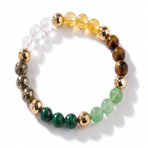
GemSense Dhan Yog Crystal Bracelet for Wealth & Financial Success
The reader-favourite place to start — five wealth stones on one wrist, SGL certificate in the box.
₹ 699₹ 1,399TL;DR: In crystal tradition, a pyrite anklet is worn on the left leg — the receiving side of the body, believed to draw abundance and confidence inward. Either leg is acceptable, though; consistency and intention matter more than the side. First-timers traditionally begin on a Friday morning after a bath, cleanse the anklet, set an intention, and remove it before bathing since water dulls raw pyrite.
Pyrite anklets have quietly become one of India's most-searched crystal accessories — and it's easy to see why. That golden metallic shimmer sits beautifully against the skin, it pairs with everything from office wear to festive outfits, and it carries one of the oldest associations in crystal tradition: abundance. Pyrite's nickname, "fool's gold," undersells it — for centuries, this iron sulphide mineral has been treated as a symbol of wealth, willpower, and self-belief.
But the moment your anklet arrives, the questions begin. Which leg does it go on? Is there a right day to wear a pyrite anklet for the first time? Can you sleep in it? Shower in it? Does it have side effects? This guide answers every one of those questions clearly — what tradition says, what's practical, and what's simply myth. If you're still weighing up whether pyrite is right for you, our companion guide on pyrite anklet benefits covers the "why"; this article covers the "how."
Which Leg Should You Wear a Pyrite Anklet On?
Tradition favours the left leg. In energy work, the left side of the body is considered the receiving side — the channel through which you draw energy inward. Since pyrite is associated with attracting wealth, confidence, and opportunity, wearing it on the left ankle is believed to help you receive those intentions. That said, either leg is perfectly acceptable.
The left-side rule comes from a simple idea found across many energy traditions: the left hand and left side receive, while the right side gives and projects. When people wear crystals meant to attract something — abundance, calm, protection — they typically place them on the receiving side. A pyrite anklet on the left ankle follows that same logic.
What if the left ankle simply doesn't work for you? Perhaps your payal sits there, or the clasp irritates that side, or you just prefer the right. Wear it on the right — nothing in tradition treats this as harmful or "wrong." Many practitioners actually suggest the right leg for people who feel they give away too much energy and want to project confidence outward, for instance before presentations or negotiations.
The honest summary: the leg is a preference wrapped in tradition, not a law. What most teachers agree on is consistency. Pick a side, wear it regularly, and let the anklet become a daily anchor for your intention rather than switching ankles based on whichever article you read last.
Left Leg vs Right Leg at a Glance
- Left leg (traditional choice): the receiving side — associated with drawing in abundance, stability, and self-worth.
- Right leg (also fine): the projecting side — associated with expressing confidence and action outward.
- Already wear a payal? Keep your silver payal and pyrite anklet on separate ankles for comfort, or stack them if the fit allows — tradition has no objection either way.
- Golden rule: choose once, stay consistent, and focus on the intention rather than the anatomy.
Which Day Should You Wear a Pyrite Anklet for the First Time?
Friday is the traditional day to wear a pyrite anklet for the first time. In Indian tradition, Friday is associated with Goddess Lakshmi and Venus (Shukra) — both connected to wealth, beauty, and prosperity, which aligns naturally with pyrite's abundance symbolism. Wear it in the morning, after your bath, when you feel fresh and unhurried.
Why Friday specifically? Pyrite's core association in crystal tradition is material abundance and self-confidence. In the Indian week, Friday belongs to Lakshmi — the goddess of wealth and grace — and to Venus, the planet of luxury and attraction in Vedic thought. Starting a wealth-intention crystal on Lakshmi's day feels natural to most Indian wearers, which is why the Friday convention took hold.
Some practitioners also suggest Sunday, linking pyrite's golden lustre and fire-element energy to the Sun — a symbol of vitality and personal power. Both days are considered auspicious; Friday is simply the more widely followed choice for pyrite.
As for the time of day: morning is preferred not because evening is inauspicious, but because a calm morning after bathing gives you a clean, focused start — you set your intention when your mind is fresh rather than at the end of a tiring day. And if your anklet arrives on a Tuesday and you can't wait? Wear it. Missing the "right" day does not undo anything. The day is a beautiful convention that adds meaning to the ritual, not a gate that locks you out. When you want to wear a pyrite anklet matters far less than how consistently and mindfully you wear it.
How Do You Wear a Pyrite Anklet for the First Time?
First-time wearing is simple: cleanse the anklet, hold it with a clear intention, then fasten it on your left ankle on a Friday morning after your bath. The whole ritual takes five minutes. The point is not ceremony for its own sake — it's marking the moment so the anklet carries personal meaning from day one.
Here is the traditional first-time ritual, step by step:
- Cleanse the anklet — without water. Pyrite is an iron sulphide, so skip the salt-water soak used for quartz crystals. Instead, pass the anklet through the smoke of an incense stick or a few loops over a burning diya, or simply place it in morning sunlight for ten to fifteen minutes. In crystal tradition, this clears any energy the piece picked up on its journey to you.
- Bathe and settle yourself. Traditionally you wear a new crystal fresh after your morning bath, in clean clothes, with a calm mind.
- Hold it and set an intention. Sit quietly for a minute, hold the anklet in your palms, and state — silently or aloud — what you're inviting in: steadier finances, courage at work, discipline with money, self-belief. Keep it specific and positive.
- Fasten it on your chosen ankle. Left is traditional; either works. Check the fit — snug enough not to catch on things, loose enough to move freely.
- Wear it consistently. For the first few weeks, wear it daily so it becomes part of your routine. Remove it for bathing and swimming (more on that below).
If you already wear a pyrite bracelet, the ritual is identical — our guide on how to wear a pyrite bracelet walks through the wrist version, and the two pieces are often worn together by people who like a coordinated set.
Can You Wear a Pyrite Anklet While Sleeping or Bathing?
Bathing: no — remove it. Water, soap, and shampoo dull raw pyrite's metallic lustre over time and can degrade the cord or metal findings, so take your anklet off before showers, swimming, and household wet work. Sleeping: entirely personal preference. There is no rule against it; comfort is the only real consideration.
The bathing rule is practical chemistry, not superstition. Pyrite is iron sulphide (FeS₂), and prolonged or repeated exposure to water — especially soapy, chlorinated, or salty water — encourages surface oxidation. Over months, that shows up as a dulled, darkened finish on what should be a bright golden-metallic stone. Anklets take more punishment than bracelets here because feet get washed constantly: showers, rain, beach trips, mopping the floor. The fix is a ten-second habit — slip the anklet off before water, put it back on after. Never soak a pyrite anklet in water for "cleansing"; use incense smoke or sunlight instead.
On the question "can we wear pyrite anklet while sleeping" — tradition genuinely has no prohibition. Some wearers keep it on around the clock and say they like the continuity; others find any anklet catches on bedsheets or feels intrusive at night, and remove it. A sensible middle path many follow: wear it through the day, take it off at night alongside your watch and rings, and put it on fresh each morning. If you do sleep in it, just check the cord or clasp weekly, since night-time snags are the most common cause of stretched elastic and lost anklets.
Who Should Wear a Pyrite Anklet?
Anyone can wear a pyrite anklet — there is no age, gender, or zodiac restriction in crystal tradition. It is especially popular with women as a modern take on the payal, and with anyone setting intentions around career growth, financial discipline, or self-confidence. Men wear pyrite anklets too, usually in simpler bead-only designs.
The pyrite anklet for women has become a category of its own in India, and the appeal is easy to understand: it sits exactly where a payal does, but in warm golden-metallic tones instead of silver. That makes it a natural bridge between tradition and contemporary style — familiar on the ankle, fresh in the look. Common pairings include:
- Office and daily wear: a single strand of small pyrite beads under trousers or with kurtis — subtle enough for formal settings, visible enough to feel personal.
- Festive and occasion wear: pyrite's golden sheen complements gold jewellery and rich fabrics beautifully during Diwali, weddings, and pujas.
- Layered styling: stacked with a slim silver payal or a black-thread anklet for contrast.
By tradition, the people most drawn to pyrite are those working on wealth and willpower intentions — entrepreneurs building something new, professionals pushing for a promotion, students preparing for competitive exams, or anyone trying to build steadier money habits. In crystal belief, pyrite is a stone of action: it's associated not with luck falling from the sky, but with the confidence and persistence to earn what you're seeking. If that framing resonates, pyrite fits. Browse the full crystal anklets collection to compare pyrite with other stones and find the design that suits your ankle size and style.
Does a Pyrite Anklet Have Side Effects?
No — wearing a pyrite anklet has no physical side effects. It is an external accessory, exactly like any other piece of jewellery. The only genuine considerations are practical: rare skin sensitivity to metal clasps or findings (not to the pyrite itself), and the stone's dislike of water, which is a care issue, not a health one.
It's worth addressing this directly, because "pyrite anklet side effects" is a common worry — usually sparked by two half-truths circulating online. First: "pyrite is toxic." Pyrite contains iron and sulphur, and crushed or heated pyrite dust is indeed something to avoid — but a polished, intact bead worn on your ankle releases nothing into your skin. Wearing pyrite jewellery is safe; grinding it into powder or soaking it long-term in water (which can produce mild acidic residue on the stone's surface) are the things to avoid. Simply keep it dry and don't wear beads that have visibly crumbled or corroded.
Second: "wrong-leg or wrong-day wearing causes harm." No tradition of substance supports this. If an anklet feels uncomfortable, heavy, or distracting, that's a fit-and-comfort issue — resize it, restring it, or take a break from wearing it. Some believers describe an "adjustment period" of feeling restless with a new stone; whether you treat that as energetic or simply as getting used to new jewellery, it passes and it is not harm.
The realistic checklist is short: if you have sensitive skin, choose a design with hypoallergenic findings or a simple elastic bead strand with no metal at all; remove the anklet before bathing; and wipe it dry if it gets sweaty. That's it. We've written a fuller myth-vs-fact breakdown in our guide to pyrite bracelet side effects — everything there applies equally to anklets.
How Do You Know Your Pyrite Anklet Is Real?
Real pyrite has a brass-gold metallic lustre, noticeable weight for its size, and often visible cubic or angular crystal faces. Fakes are usually painted hematite, coated glass, or plastic — lighter, too-uniform, or golden only on the surface. The definitive proof is an SGL gemmological lab certificate identifying the stone as natural pyrite.
Here's what to check at home:
- Colour and lustre: genuine pyrite is pale brass-gold with a hard metallic shine — not yellow-gold like jewellery gold, and not glittery like coated glass. If beads look identical in colour from every angle with zero natural variation, be suspicious.
- Weight: pyrite is dense (heavier than it looks). A pyrite anklet has a distinct heft; plastic imitations feel almost weightless.
- Structure: look closely — natural pyrite often shows tiny cubic facets, striations, or angular growth patterns. Perfectly smooth, flawless golden spheres across an entire strand suggest coating.
- Scratch test (discreetly): pyrite is reasonably hard (6–6.5 on the Mohs scale). Paint on a coated hematite or glass bead scratches off to reveal grey or clear material beneath; real pyrite stays metallic through and through.
- Temperature: like most real stone and metal, pyrite feels cool when first touched, warming slowly against skin. Plastic feels room-temperature immediately.
Home tests narrow it down, but the only conclusive answer comes from a laboratory. Every GemSense pyrite anklet ships with an SGL gemmological lab certificate — an independent lab's confirmation that the beads are natural pyrite, not coated imitations. If you're buying elsewhere, ask the seller for lab certification before paying; a genuine seller will have it ready. For a deeper walkthrough of authenticity checks that work across all crystals, see our guide on how to check if a crystal bracelet is real.
Pyrite Anklet Wearing Rules: Quick Summary Table
Every rule from this guide in one place — screenshot-friendly:
| Question | Traditional answer |
|---|---|
| Which leg? | Left leg (the receiving side); right leg is also fine — consistency matters most |
| Which day to start? | Friday (Lakshmi/Venus day); Sunday is an accepted alternative |
| What time? | Morning, after your bath, with a calm mind |
| First-time ritual? | Cleanse with incense smoke or sunlight (never water), set an intention, fasten on the ankle |
| Bathing or swimming? | Remove it — water and soap dull raw pyrite and weaken the cord |
| Sleeping? | Personal preference — no rule against it; remove it if it snags or disturbs sleep |
| Cleaning the stone? | Wipe with a soft dry cloth; recharge in morning sunlight or incense smoke |
| Who can wear it? | Anyone — no gender, age, or zodiac restriction in crystal tradition |
The Rule Behind All the Rules
If you remember one thing from this guide, make it this: the leg, the day, and the ritual exist to give your intention a beginning — they are supports, not tests. Left ankle, Friday morning, a smoke cleanse, a quiet moment of purpose: follow them because they make the anklet meaningful, not because breaking them breaks anything. In crystal tradition, pyrite is a companion for effort — the golden reminder on your ankle that abundance is built through confidence, discipline, and daily action. Wear it consistently, keep it dry, insist on lab-certified stone, and let the anklet do what jewellery with meaning has always done in India: keep your intention where you can see it.
Crystals are a beautiful spiritual tradition, not medicine. They don't replace medical care, professional advice, or your own effort.
Shop the crystals in this guide
Certified & Energised
GemSense Dhan Yog Crystal Bracelet for Wealth & Financial Success
The reader-favourite place to start — five wealth stones on one wrist, SGL certificate in the box.
₹ 699₹ 1,3996 Mukhi Rudraksha Benefits: Kartikeya's Bead for Confidence, Focus & Expression
5 मुखी रुद्राक्ष के फायदे: पंचमुखी रुद्राक्ष किसे और कैसे पहनना चाहिए
Related Posts

Rudraksha Mala Guide: Japa Rules, 108 vs 54 vs 32 Beads & How to Spot an Original

5 मुखी रुद्राक्ष के फायदे: पंचमुखी रुद्राक्ष किसे और कैसे पहनना चाहिए

6 Mukhi Rudraksha Benefits: Kartikeya's Bead for Confidence, Focus & Expression


