

7 Mukhi Rudraksha Benefits: Mahalakshmi's Bead for Wealth & Sade Sati
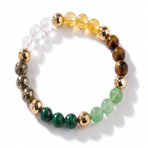
Certified & Energised
GemSense Dhan Yog Crystal Bracelet for Wealth & Financial Success
The reader-favourite place to start — five wealth stones on one wrist, SGL certificate in the box.
₹ 699₹ 1,399The 7 Mukhi (Saptamukhi) Rudraksha is the seven-faced bead of Goddess Mahalakshmi, governed by Shani (Saturn). In Vedic tradition it is worn to invite wealth, financial steadiness and discipline, and to ease the pressures of Sade Sati — Saturn's roughly seven-and-a-half-year transit over your Moon sign. Anyone can wear it, and no astrological consultation is needed to begin.
Few beads are searched for as anxiously as the seven-faced Rudraksha. People usually arrive at it for one of two reasons: money feels stuck, or an astrologer has told them Sade Sati has begun. Both instincts point to the same bead. In the living Jyotish tradition the Saptamukhi is the bead of prosperity and of making peace with Saturn — the two things, oddly enough, that tend to be tangled together. This guide walks through what the bead actually is, what tradition promises (and what it does not), how Sade Sati works, and how to wear and verify a genuine bead.
What Is 7 Mukhi Rudraksha?
A Rudraksha is the dried seed of the Elaeocarpus ganitrus tree, which grows in the Himalayan foothills of Nepal, India and Indonesia. Each seed is naturally divided by raised vertical lines called mukhi (faces). A seven-faced bead carries seven of these lines running cleanly from the crown to the base — and, crucially, seven internal seed compartments to match. The word "Saptamukhi" simply means "seven-faced" (sapta = seven).
The number seven echoes everywhere in Indian thought: the Sapta Matrika (seven mother goddesses), the Saptarishi (seven great sages), the seven musical notes and the seven energy centres of the body. Tradition maps all of this abundance onto the Saptamukhi, which is why it is regarded as a bead of fullness, fortune and overflow rather than austerity. You can see a certified example on the 7 Mukhi Rudraksha single bead page.
The Deity & Planet: Mahalakshmi, Shani and the Sapta Matrika
In the everyday Jyotish tradition, the presiding deity of the 7 Mukhi Rudraksha is Goddess Mahalakshmi — the goddess of wealth, prosperity and well-being — while its ruling planet is Shani (Saturn). The seven faces are also said to be blessed by the Sapta Matrika, the seven mother goddesses who bestow abundance and protection. This double signature — Lakshmi's grace plus Saturn's discipline — is exactly why the bead is recommended both for prosperity and for navigating Saturn's testing periods.
The scriptural anchor for Rudraksha lore is the Shiva Purana. In its Vidyeśvara Saṃhitā, Chapter 25 ("The Greatness of Rudrākṣa"), the seven-faced bead is named and praised directly:
"A Rudrākṣa with seven faces, O Maheśāni, is called Anaṅga. O Deveśī, by wearing it even a poor man becomes a great lord." — Shiva Purana, Vidyeśvara Saṃhitā 25.72
That single line captures the entire promise of the Saptamukhi: the elevation of one's material station. The same chapter names the five-faced bead "Kālāgni" (Rudra himself, verse 69) and the six-faced bead as Kārtikeya (verse 71), which is useful context when you compare faces later on.
7 Mukhi Rudraksha Benefits (As Traditional Belief)
It is important to read what follows as spiritual and astrological tradition, not as a guarantee. The Saptamukhi is a support for your own effort and faith, never a substitute for sound financial planning or professional advice. With that framing, here is what wearers and classical texts traditionally associate with the bead:
- Wealth and prosperity. As Mahalakshmi's bead, it is the classic Rudraksha for inviting financial abundance, fresh income avenues and good fortune in business and trade.
- Financial stability. Beyond attracting money, tradition values the 7 Mukhi for helping retain it — curbing wasteful spending, steadying cash flow and supporting better money decisions.
- Relief from Saturn's pressure. Governed by Shani, it is the go-to bead for those feeling the weight of Saturn through Sade Sati, Shani Dhaiya or a Shani Mahadasha.
- Focus and discipline. Saturn rewards patience and consistency. Wearers report steadier concentration, more discipline and a calmer, more grounded approach to work.
- Emotional steadiness. Many describe a settling of anxiety around money and the future, and a renewed sense of perseverance through difficult phases.
Disclaimer: Rudraksha is a traditional spiritual and astrological aid. It does not diagnose, treat, cure or prevent any disease, and it is not a substitute for professional medical or financial advice.
Sade Sati Explained — and Why 7 Mukhi Is Recommended
Sade Sati (literally "seven and a half") is the roughly 7.5-year period when Shani transits the three signs centred on your rashi (Moon sign): the 12th house from your Moon, then your Moon sign itself, then the 2nd house from it. Because Saturn spends about 2.5 years in each sign, the full passage takes around seven and a half years, unfolding in three distinct phases:
- Rising phase (12th house from Moon, ~2.5 years): often felt as rising expenses, restlessness and a sense of things draining away.
- Peak phase (over the Moon sign, ~2.5 years): traditionally the most intense stretch, turning the pressure inward toward work, responsibility and self-reflection.
- Setting phase (2nd house from Moon, ~2.5 years): the gradual unwinding, when lessons consolidate and finances and stability tend to recover.
A related, shorter transit is Shani Dhaiya (also called Kantaka Shani or Ashtama Shani), a ~2.5-year passage of Saturn through the 4th or 8th house from your Moon. Both periods are why the Saturn-ruled 7 Mukhi is so often recommended: the bead is believed to help you meet Shani's discipline with steadiness rather than dread. For an even stronger Saturn pairing, many people choose the Rudraksh and Karungali (black ebony) mala, traditionally favoured during Sade Sati and Shani periods. None of this overrides your chart — it is a supportive practice meant to sit alongside patience and good judgement.
Who Should Wear 7 Mukhi Rudraksha?
One of the quiet strengths of Rudraksha is that, unlike a gemstone, it carries no risk of "wrong placement," so anyone can wear it without an astrological consultation. It is, however, especially associated with:
- Anyone currently in Sade Sati, Shani Dhaiya or a Shani Mahadasha/Antardasha.
- People facing financial difficulty, debt or instability, or recurring obstacles in business and career.
- Entrepreneurs, traders and professionals who want steadier focus, discipline and decision-making.
- Anyone simply seeking Mahalakshmi's blessing of prosperity and a calmer relationship with money.
There is no gender restriction. Men, women and elders can all wear the Saptamukhi and receive its traditional benefits equally.
How to Wear and Energize 7 Mukhi Rudraksha
A Rudraksha is traditionally cleansed and energised (a small prana pratishtha or "dharana vidhi") before first wear. The ritual is simple:
- Cleanse the bead. Rinse it in clean water — and, if you wish, a little raw cow's milk and a few Tulsi leaves — then pat it dry. This clears travel and handling energy.
- Choose the day and time. Saturday morning, Shani's own day, is the classic choice; some begin on a Friday (Venus, for wealth). Bathe first and sit facing east at your altar.
- Make a simple offering. Light a diya and incense, apply a little sandalwood paste to the bead, and offer a flower.
- Chant the mantra. Recite the Saptamukhi seed mantra "Om Hum Namah" 108 times (the universal "Om Namah Shivaya" also works). On a 32-bead mala, complete the 108 across a little over three rounds, turning back at the Sumeru bead rather than crossing it.
- Wear it. String the bead on red or black silk thread, or cap it in silver, gold or panchdhatu. Wear it at the throat as a pendant, on the wrist, or — as a ring — on the middle finger of the right hand (Saturn's finger). Let it touch the skin.
- Keep it close and refresh it. Wear it daily, and re-energise with a fresh round of japa whenever you next cleanse it.
Single Bead vs Mala — Which Should You Choose?
Both forms carry the same energy; the choice is about how you intend to use it.
Choose a single 7 Mukhi bead if you want a simple daily wear — a pendant or capped bead you keep on at all times for continuous benefit. It is the most popular, lowest-fuss way to begin.
Choose a 7 Mukhi mala if you want to do regular japa (mantra repetition). The GemSense 7 Mukhi mala is a compact japa mala of 32 beads plus one Sumeru (guru) bead strung on red silk — designed to sit comfortably and to count cleanly. Because the traditional cycle is 108 repetitions, you simply complete it over a little more than three rounds of the 32 beads, pausing and reversing at the Sumeru bead each time rather than crossing it. Many people keep a single bead on the body for daily wear and a mala at the altar for practice.
7 Mukhi vs 5 Mukhi vs 6 Mukhi: A Quick Comparison
The three lowest-mukhi beads are the most common, and shoppers often weigh them against each other. Here is how they differ in tradition:
| Aspect | 7 Mukhi (Saptamukhi) | 5 Mukhi (Panchamukhi) | 6 Mukhi (Shanmukhi) |
|---|---|---|---|
| Faces | Seven | Five | Six |
| Presiding deity | Goddess Mahalakshmi (Shiva Purana: "Anaṅga") | Kālāgni Rudra — Shiva himself | Lord Kārtikeya (Murugan) |
| Ruling planet | Shani (Saturn) | Guru (Jupiter) | Shukra (Venus) / Mangal (Mars), per tradition |
| Traditionally worn for | Wealth, financial stability, Sade Sati and Saturn relief | Peace, calm, focus, all-round well-being — the universal everyday bead | Willpower, grounding, confidence and steadier relationships |
The 5 Mukhi Rudraksha bead is the most universal and is often the first Rudraksha people wear; many pair it with the Saptamukhi for an everyday balance of calm and prosperity. For daily japa there is also a 5 Mukhi mala in the same compact 32-bead format.
Original vs Fake 7 Mukhi: How to Spot a Genuine Bead
Because higher-mukhi beads are rarer and pricier, the 7 Mukhi is a common target for fakes. The single most important fact to understand is this: a Rudraksha's true face count is fixed by the seed's internal compartments, which exactly match the number of natural lines — and that internal structure cannot be faked.
Counterfeiters typically take an inexpensive low-mukhi bead and carve extra lines into the surface to imitate seven faces. Signs of tampering and imitation include:
- Carved or filled lines: faces that look chiselled, suddenly stop, or appear glued or filled, rather than running cleanly end to end.
- Unnatural smoothness: real Rudraksha has a rough, textured surface and natural mukti contours; plastic or composite imitations feel too smooth or too uniform.
- Wrong weight or join lines: beads moulded from paste or two halves may feel oddly heavy or show a seam.
Home tests (the water test, the texture check) are only indicative — a skilled carving can pass them. The reliable answer is laboratory certification. Every GemSense Rudraksha is SGL lab-certified, with the certificate shipped alongside your order, so the face count and authenticity are independently verified rather than taken on trust. You can browse certified beads across the full GemSense Rudraksha collection.
Care, Precautions and Pairing With Crystals
A well-kept Rudraksha can last for decades. A few simple habits help:
- Wipe off sweat after the day, and remove the bead before heavy gym sessions or swimming in chlorinated pools.
- Every few weeks, rub in a drop of sandalwood or olive oil to keep the seed from drying or cracking.
- Periodically recharge it — a few hours on a Selenite charging plate or under moonlight is a gentle, traditional way to cleanse its energy.
- Keep your energised bead personal; tradition advises not sharing it once it has been worn.
On "side effects": the 7 Mukhi is a soft-energy bead with no harmful effects when worn respectfully. Some people simply notice heightened emotional sensitivity in the first few days as they adjust — usually settling on its own. If a thread feels too tight or a metal cap irritates the skin, adjust the setting; that is comfort, not a spiritual warning.
For wealth-minded wearers, a popular pairing is the Saptamukhi with a Pyrite bracelet — Pyrite is the classic crystal of ambition, money and confidence, and it complements the Rudraksha's Mahalakshmi energy nicely. As always, treat these as supportive practices that sit alongside, not in place of, your own effort and sound financial planning.
Frequently Asked Questions
Can women wear 7 Mukhi Rudraksha?
Yes. There is no gender restriction. Women can wear the Saptamukhi for the same traditional benefits — prosperity, financial stability and relief during Sade Sati — and many associate it with harmony and steadiness at home.
Which day should I wear 7 Mukhi Rudraksha?
Saturday morning, Shani's own day, is the traditional choice — after a bath, sitting facing east, following the energising steps above. Some prefer to start on a Friday (Venus, the planet of wealth). Either is considered auspicious.
What is the mantra for 7 Mukhi Rudraksha?
The classic seed mantra is "Om Hum Namah," chanted 108 times when you first energise the bead and during regular japa. The universal "Om Namah Shivaya" is also perfectly acceptable.
7 Mukhi vs 5 Mukhi — which is better for money?
For wealth and financial concerns specifically, the 7 Mukhi is the traditional choice, since it is the bead of Goddess Mahalakshmi. The 5 Mukhi is the all-round bead for peace, focus and well-being. Many people wear both together.
How do I know if my 7 Mukhi is real?
Look for seven natural, unbroken lines running end to end and a rough, untreated surface — but be aware that fakes are made by carving extra lines onto cheaper beads. The dependable proof is lab certification; every GemSense bead ships with an SGL certificate.
How many beads are in a 7 Mukhi mala?
The GemSense 7 Mukhi mala is a compact japa mala of 32 beads plus one Sumeru (guru) bead on red silk — not 108. To complete a traditional 108-repetition cycle, you simply chant across a little more than three rounds, reversing at the Sumeru bead.
Is 7 Mukhi Rudraksha good for Sade Sati?
It is one of the most recommended beads for it. Because the Saptamukhi is ruled by Shani (Saturn), tradition holds that it helps you move through Sade Sati's three phases with more steadiness. For a stronger Saturn focus, a Rudraksh and Karungali mala is a popular companion.
Which finger or hand should I wear it on?
As a ring, the middle finger of the right hand — Saturn's finger — is traditional. Most people, though, wear it as a pendant at the throat or on the wrist; what matters is that the bead can touch the skin.
Can I wear 5 Mukhi and 7 Mukhi together?
Yes, and it is a common combination — the 5 Mukhi for calm and clarity, the 7 Mukhi for prosperity and Saturn support. Rudraksha beads are harmonious with one another, so there is no conflict in wearing them together.
Can I wear my Rudraksha while sleeping or bathing?
You can keep it on most of the time. It is gentlest to remove it during long, hot showers or heavy sweating and to wipe it dry afterwards, simply to protect the seed and thread over the years. Some prefer to set it aside at night and place it at the altar.
How long does it take to feel the effects?
There is no fixed timeline; tradition speaks of consistent daily wear and faith rather than instant results. Treat it as a steady, supportive practice over weeks and months, paired with your own effort.
Does the 7 Mukhi Rudraksha have any side effects?
No harmful ones. It is a soft-energy bead; at most, some wearers feel a little more emotionally sensitive in the first few days as they settle in. It is a spiritual aid, not a medical or financial guarantee.
Bringing It All Together
The 7 Mukhi Rudraksha endures because it speaks to two of life's most pressing concerns at once — the wish for prosperity and the need to weather Saturn's harder seasons. Worn with a little ritual, a simple mantra and steady faith, the Saptamukhi is a beautiful companion through Sade Sati and beyond. Choose a genuine, lab-certified bead, care for it well, and let it support the work you are already doing. When you are ready, explore certified single beads and malas in the GemSense Rudraksha collection — and may Mahalakshmi's grace and Shani's steadiness travel with you.
Shop the crystals in this guide
Certified & Energised
GemSense Dhan Yog Crystal Bracelet for Wealth & Financial Success
The reader-favourite place to start — five wealth stones on one wrist, SGL certificate in the box.
₹ 699₹ 1,399Which Hand Should You Wear a Crystal Bracelet On? (Left vs Right, Explained)
How to Cleanse and Charge a Crystal Bracelet (5 Simple Methods)
Related Posts

Rudraksha Mala Guide: Japa Rules, 108 vs 54 vs 32 Beads & How to Spot an Original

5 मुखी रुद्राक्ष के फायदे: पंचमुखी रुद्राक्ष किसे और कैसे पहनना चाहिए

How to Wear a Pyrite Anklet: Which Leg, Which Day & the Rules That Matter

6 Mukhi Rudraksha Benefits: Kartikeya's Bead for Confidence, Focus & Expression


