

6 Mukhi Rudraksha Benefits: Kartikeya's Bead for Confidence, Focus & Expression
Certified & Energised
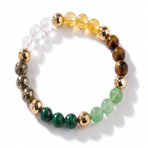
GemSense Dhan Yog Crystal Bracelet for Wealth & Financial Success
The reader-favourite place to start — five wealth stones on one wrist, SGL certificate in the box.
₹ 699₹ 1,399TL;DR: The 6 mukhi rudraksha is the bead of Lord Kartikeya, the six-faced warrior son of Shiva, and is ruled by Venus (Shukra). In Vedic tradition it is believed to build confidence, sharpen focus, and free the wearer's voice — which is why it has long been favoured by artists, speakers, performers, and students who freeze under pressure. Wear it energised with the mantra "Om Hreem Hum Namah", and buy only beads whose six natural lines are verified by a SGL lab certificate.
Some rudraksha beads are worn for peace. The 6 mukhi is worn for courage of a very specific kind — the courage to stand up, speak, perform, create, and be seen. In Indian households it is the bead elders quietly suggest for the child who knows the answer but never raises a hand, the young professional who dreads presentations, and the singer who is flawless at riyaaz but shaky on stage.
Its story explains its character. The six faces (mukhis) of this bead are said to represent Shanmukha — "the six-faced one" — a name of Lord Kartikeya, the commander of the celestial armies. Kartikeya is the deity of victory earned through discipline, and of youthful brilliance expressed without hesitation. Add Venus, the planet of art, charm, and refinement, as its ruling graha, and you get a bead whose entire tradition points one way: toward confident, polished self-expression.
In this guide we will walk through the 6 mukhi rudraksha benefits as Vedic tradition describes them, who should wear this bead, its ruling planet and deity, the correct wearing method and mantra, how it differs from the 5 mukhi and 7 mukhi, and — because the market is full of lookalikes — how to make sure the bead on your wrist is real.
What Are the Benefits of Wearing 6 Mukhi Rudraksha?
In Vedic tradition, the six mukhi rudraksha benefits centre on confidence, focus, and expression. The bead is believed to steady stage fear, strengthen willpower and concentration, refine speech and creative flow, and support emotional balance. As Kartikeya's bead ruled by Venus, it is associated with disciplined effort meeting artistic grace — courage delivered with polish.
Let us unpack that. Rudraksha benefits are always described in the language of tradition and intention, not laboratory measurement, and the 6 mukhi's traditional profile is remarkably consistent across classical texts and living practice:
- Confidence and courage: As the bead of the divine commander, it is believed to dissolve hesitation and performance anxiety — the "freeze" before an exam viva, audition, or client pitch.
- Focus and willpower: Kartikeya's single-pointed spear (the vel) symbolises one-pointed concentration. Wearers traditionally use the bead as an anchor for disciplined study and practice.
- Expression and speech: Venus governs art, beauty, and communication. The 6 mukhi is believed to help thoughts flow into words, songs, brushstrokes, and performances without the inner censor slamming the brakes.
- Emotional steadiness: Tradition links the bead to a calmer, more grounded emotional state, so that criticism and setbacks do not derail creative work.
- Charisma and grace: Venus's influence is said to lend warmth and magnetism to the wearer's presence — useful for anyone whose work depends on holding a room.
None of this is a substitute for practice, preparation, or professional help where needed. The bead, in the traditional view, is a daily reminder and an energetic ally — you still do the riyaaz, the revision, the rehearsal.
Who Should Wear 6 Mukhi Rudraksha?
The 6 mukhi rudraksha is traditionally recommended for artists, singers, actors, public speakers, teachers, content creators, salespeople, lawyers, and students facing stage fear or interview nerves. Anyone whose growth depends on expressing themselves — on stage, on camera, in a boardroom, or in an exam hall — is considered a natural wearer of Kartikeya's bead.
Think of the moments where this bead's tradition speaks loudest. A student who studies sincerely but goes blank in viva voce. A young professional whose ideas are excellent on paper but who shrinks in meetings. A classical vocalist preparing for her first solo concert. A founder recording his first product video, take after awkward take. In Vedic tradition, these are precisely the people the 6 mukhi was meant for — which is why at GemSense we position our 6 Mukhi Rudraksha (Shanmukhi) as the bead "For Creators & Speakers".
Astrologically, those with a weak or afflicted Venus in their birth chart are often advised this bead by traditional astrologers, since it is Shukra's rudraksha. But you do not need a chart reading to wear it. Rudraksha tradition is generous: men and women of any age, any community, and any stage of life may wear the 6 mukhi with respect and clear intention. If your goal this year is to be heard — in your art, your career, or your classroom — this is the bead tradition points you toward.
Which Planet and Deity Rule the 6 Mukhi Rudraksha?
The 6 mukhi rudraksha is ruled by the planet Venus (Shukra) and governed by Lord Kartikeya, the six-faced son of Shiva also known as Shanmukha, Murugan, Skanda, and Subrahmanya. Venus brings art, charm, and refinement; Kartikeya brings courage, focus, and victory. Together they define the bead's identity: disciplined confidence expressed beautifully.
If you have ever wondered "6 mukhi rudraksha which planet?" — the answer is Venus, and the pairing is beautifully logical. In Jyotish, Shukra is the graha of aesthetics, relationships, comfort, and creative talent. When Venus is strong, tradition says, a person's work carries polish and appeal; when weak, talent stays trapped inside, unexpressed. The 6 mukhi is worn as Shukra's bead to invite that expressive grace.
Kartikeya's side of the story supplies the steel. Born to destroy the demon Tarakasura when no one else could, Kartikeya is the eternal commander — young, radiant, and utterly focused. His six faces are said to see in all directions at once, symbolising complete awareness, and each face of the bead is traditionally mapped to one of his six aspects. In South India, where he is worshipped as Murugan, devotees invoke him before competitions and examinations to this day.
So the 6 mukhi carries a double signature rare among rudraksha: a warrior's nerve and an artist's finish. That is why the tradition hands it to performers rather than renunciates — it is a bead for engaging with the world, not withdrawing from it.
How Do You Wear 6 Mukhi Rudraksha?
Traditionally, a 6 mukhi rudraksha is worn on the right wrist or around the neck, strung in silk thread, copper, or silver. Energise it on a Friday (Venus's day) or Monday morning: bathe, sit facing east, place the bead on a clean cloth, and chant "Om Hreem Hum Namah" 108 times before wearing it with your intention.
Here is the simple ritual most traditional wearers follow:
- Choose the day: Friday is ideal because it belongs to Shukra, the bead's ruling planet. Monday, Shiva's day, is an equally respected choice.
- Purify: After bathing, rinse the bead gently with clean water (some households use raw milk followed by water), and let it dry on a fresh cloth.
- Energise (prana pratishtha): Sitting quietly, ideally facing east, chant the beeja mantra "Om Hreem Hum Namah" 108 times. Many wearers also add "Om Namah Shivaya" or a short prayer to Kartikeya.
- Set your intention: State plainly what you are working toward — the performance, the exam, the launch. Tradition holds that a rudraksha worn with sankalpa (resolve) serves you best.
- Wear it consistently: A bracelet on the right wrist keeps the bead in contact with skin through your working day. Remove it before sleep if you prefer, and keep it away from harsh soaps and perfumes.
If you plan to wear multiple beads or want to understand thread choices, bead counts, and daily care in depth, our rudraksha mala guide walks through the full tradition step by step. The short version: treat the bead like the sacred object it is, and it will quietly become part of your daily discipline.
6 Mukhi vs 5 Mukhi: Which One Should You Choose?
Choose the 5 mukhi for general peace, everyday balance, and a first rudraksha; choose the 6 mukhi when your specific goal is confidence, focus, and self-expression. The 5 mukhi is Jupiter's bead of calm wisdom, while the 6 mukhi is Venus's bead of courageous creativity. Many wearers eventually keep both.
The 6 mukhi vs 5 mukhi rudraksha question comes up constantly, and the honest answer is that they are teammates, not rivals. The 5 mukhi — ruled by Jupiter (Guru) and linked to Kalagni Rudra, a form of Shiva — is the universal bead: gentle, steadying, suitable for absolutely everyone, and the classic starting point. The 6 mukhi is a specialist. It takes that foundation of calm and aims it outward, toward the stage, the studio, and the spotlight.
A useful way to decide: ask what your next six months demand. If the answer is "less anxiety, better routine, more inner quiet", start with the 5 mukhi. If the answer is "I must present, perform, publish, or speak up — and fear is the bottleneck", the 6 mukhi is your bead. Here is how the two compare, alongside the 7 mukhi, which serves a different purpose again:
| Mukhi | Deity | Planet | Best for |
|---|---|---|---|
| 5 Mukhi | Kalagni Rudra (Shiva) | Jupiter (Guru) | Everyday peace, calm, meditation — the classic first rudraksha |
| 6 Mukhi | Lord Kartikeya (Shanmukha) | Venus (Shukra) | Confidence, focus, stage presence — creators, speakers, students |
| 7 Mukhi | Goddess Mahalakshmi | Saturn (Shani) | Abundance, stability, steady progress through hard phases |
Tradition places no bar on combining them. A 5 mukhi for daily equilibrium with a 6 mukhi worn before performances is a pairing many artists settle into naturally.
How Do You Check If a 6 Mukhi Rudraksha Is Real?
The only reliable proof of a genuine 6 mukhi rudraksha is an SGL lab certificate confirming six internal seed compartments matching the six external lines. Carved fakes and bhadraksh lookalikes can fool the eye, but not a gemmological lab. Every GemSense rudraksha ships with its own SGL certificate for exactly this reason.
This section matters more than any other, because the rudraksha market rewards dishonesty. Higher-mukhi beads command attention, so unscrupulous sellers take a common bead and carve extra lines into its surface, or sell bhadraksh — a similar-looking seed from a related tree that holds no place in rudraksha tradition — as the real thing. To an untrained eye on a product photo, a carved fake and a genuine bead look identical.
Here is what actually separates a real bead from a fake:
- SGL lab verification (the gold standard): A true 6 mukhi has six internal compartments, each naturally housing a seed, corresponding to its six surface lines. Gemmological lab testing confirms these chambers. Carved lines have no chambers behind them — the fraud is visible in one image. This is why every rudraksha at GemSense ships with a SGL lab certificate specific to that bead.
- Natural, unbroken mukhi lines: Genuine lines run continuously from the top hole to the bottom of the bead. Carved lines often look too neat, too shallow, or stop abruptly.
- Surface character: Real rudraksha have irregular, thorny, organic surfaces. Suspiciously smooth, uniform beads deserve suspicion.
- Ignore folk tests: The floating-in-water test and the "spinning between copper coins" test are unreliable folklore — density varies with origin and moisture, and both real and fake beads can pass or fail them.
The practical rule: never buy a rudraksha without a bead-specific SGL certificate, whatever the seller's story. You can browse our full SGL-certified rudraksha collection to see what transparent certification looks like — each listing's bead is the bead that was scanned.
Common Questions About the 6 Mukhi Rudraksha
Can students wear 6 mukhi rudraksha?
Yes — students are among its most traditional wearers. Kartikeya is invoked across India before examinations and competitions, and the 6 mukhi is believed to support concentration during study and composure during vivas, interviews, and presentations. It is often suggested for students who prepare well but underperform when all eyes turn to them.
Can women wear 6 mukhi rudraksha?
Absolutely. Rudraksha tradition places no gender restriction on the 6 mukhi. Women artists, teachers, anchors, and entrepreneurs wear it for the same reasons men do — expression, confidence, and Venusian grace. The only traditional etiquette, common to all rudraksha, is to treat the bead with respect and keep it clean.
Which hand should I wear a 6 mukhi bracelet on?
The right wrist is the traditional preference, as the right side is associated with outward action and expression — exactly this bead's domain. That said, many traditions consider either wrist acceptable if worn with sincerity. Consistency and intention matter more than the wrist you choose.
How many beads should I wear?
A single well-certified 6 mukhi worn as a bracelet or pendant is entirely sufficient in tradition. Some wearers prefer multiple beads strung together for a fuller mala; if you go that route, choose an odd count and read up on stringing etiquette before you do.
Can I wear 6 mukhi with other rudraksha?
Yes. The 6 mukhi combines harmoniously with the 5 mukhi (calm plus confidence) and the 7 mukhi (expression plus abundance) — tradition records no conflict among these beads. Combining is a matter of intention, not restriction: wear the beads whose purposes match the life you are building.
Caring for Your 6 Mukhi Rudraksha
A rudraksha is a seed, and seeds respond to care. Keep your 6 mukhi away from chemical soaps, perfumes, and chlorinated pools; remove it before swimming or heavy sweating if you can. Clean it occasionally with a soft brush and plain water, dry it fully, and lightly oil it with a drop of pure coconut or sandalwood oil once every few months to prevent the surface from drying and cracking in Indian summers.
Store it respectfully — a small cloth pouch near your puja space is ideal — and re-chant the mantra whenever you feel your connection to the practice has gone mechanical. A well-kept 6 mukhi darkens gracefully with years of wear, and many wearers pass their beads on within the family, along with the stories of what was faced and won while wearing them.
That, finally, is the real promise of Kartikeya's bead. Not magic, but a daily, tactile commitment to your own voice — renewed every time the bead touches your skin before you walk on stage, into the exam hall, or in front of the camera.
Rudraksha is a sacred spiritual tradition, not medicine. It does not replace medical care, professional advice, or your own effort.
Shop the crystals in this guide
Certified & Energised
GemSense Dhan Yog Crystal Bracelet for Wealth & Financial Success
The reader-favourite place to start — five wealth stones on one wrist, SGL certificate in the box.
₹ 699₹ 1,3995 Mukhi Rudraksha Benefits: What Panchmukhi Actually Does & Who Should Wear It
How to Wear a Pyrite Anklet: Which Leg, Which Day & the Rules That Matter
Related Posts

Rudraksha Mala Guide: Japa Rules, 108 vs 54 vs 32 Beads & How to Spot an Original

5 मुखी रुद्राक्ष के फायदे: पंचमुखी रुद्राक्ष किसे और कैसे पहनना चाहिए

How to Wear a Pyrite Anklet: Which Leg, Which Day & the Rules That Matter


