

Rudraksha Mala Guide: Japa Rules, 108 vs 54 vs 32 Beads & How to Spot an Original
Certified & Energised
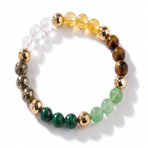
GemSense Dhan Yog Crystal Bracelet for Wealth & Financial Success
The reader-favourite place to start — five wealth stones on one wrist, SGL certificate in the box.
₹ 699₹ 1,399TL;DR: A rudraksha mala is a string of sacred rudraksha beads — traditionally 108 plus one meru bead — used for japa (mantra repetition) and worn as a mark of devotion to Shiva. Count with your thumb and middle finger, never cross the meru, and complete 108 repetitions per round. Bead counts of 54, 32 and 27 serve shorter practice or daily wear. Authenticity is proven by SGL lab certification, not home tricks.
Walk into any temple town in India — Kashi, Rishikesh, Ujjain — and you will see rudraksha malas everywhere: around the necks of sadhus, wrapped over the wrists of pilgrims, moving quietly through the fingers of someone doing japa on a ghat at dawn. The mala is one of the oldest spiritual tools in the Indian tradition, and yet most buyers today receive no guidance on how to use one, which bead count to choose, or how to tell an original rudraksha mala from the flood of fakes sold online. This pillar guide covers all of it — japa rules, bead counts, mukhi selection, men's and women's wear, authenticity testing and daily care — so your mala becomes a lifelong companion in practice, not just an accessory.
What Is a Rudraksha Mala?
A rudraksha mala is a prayer garland strung from the dried seeds of the Elaeocarpus ganitrus tree, sacred to Lord Shiva. Tradition holds the beads arose from Shiva's tears — rudra (Shiva) plus aksha (tear or eye). It is used for japa meditation and worn as a devotional necklace.
Each rudraksha bead carries natural vertical grooves called mukhi (faces) running from top to bottom. A bead with five grooves is a 5 mukhi, seven grooves a 7 mukhi, and so on — each mukhi is associated in the Puranas with a different deity, planet and quality. A full japa mala strings 108 of these beads plus one extra bead, the meru or sumeru, which sits outside the counting circle and marks the start and end of each round. Shorter strands — 54, 32 or 27 beads — follow the same logic in fractions of 108.
Two things separate a genuine mala from a decorative one: the beads must be real rudraksha (not the lookalike bhadraksh seed, wood or plastic), and the stringing must respect the tradition — beads facing uniformly, a meru present on a japa mala, and a knotted thread or strong cord that survives daily use. Everything else in this guide builds on that foundation.
What Are the Benefits of Wearing a Rudraksha Mala?
In the Shaiva tradition, wearing a rudraksha mala is believed to steady the mind, support meditation, protect the wearer and keep them in constant remembrance of Shiva. These are matters of faith and centuries of lived practice — the mala is a spiritual discipline tool, not a medical device.
The Shiva Purana and Devi Bhagavata describe rudraksha as dear to Shiva and speak of the wearer gaining his grace. In day-to-day practice, devotees describe the benefits of a rudraksha mala in more grounded terms:
- An anchor for daily sadhana. A mala on your neck or in your japa bag is a physical commitment. It makes skipping practice harder and returning to it easier.
- Focus during japa. The moving beads give restless fingers a task, so the mind can stay with the mantra instead of counting mentally.
- A felt sense of calm and protection. Tradition associates rudraksha with a cooling, sattvic influence; many wearers say the beads help them respond to stress with more composure.
- Remembrance. Every time the mala touches your skin or catches your eye, it recalls your intention — the quality Indian tradition calls smarana.
Be wary of sellers promising cures, guaranteed wealth or instant results. The honest framing is this: a rudraksha mala supports the effort you put in. It deepens a practice; it does not replace one.
How Do You Do Japa With a Rudraksha Mala?
Hold the mala in your right hand, drape it over the middle finger, and pull one bead toward you with your thumb for each mantra repetition. Never use the index finger. Start at the bead beside the meru, complete 108 repetitions, and when you reach the meru again, do not cross it — turn the mala around and continue in the reverse direction.
Japa — the meditative repetition of a mantra — is the primary purpose of a 108 rudraksha mala, and the traditional method matters as much as the count. Here is the full sequence followed in most Shaiva and Vedic lineages:
- Sit facing east or north after bathing or at least washing your hands, ideally at a consistent time — brahma muhurta (pre-dawn) is classical, but consistency beats timing.
- Hold the mala at heart level in the right hand, resting on the middle finger. The index finger — associated with the ego in this tradition — should not touch the beads.
- Begin at the bead next to the meru. Recite your mantra — Om Namah Shivaya is the universal choice for rudraksha — once per bead, drawing each bead over with the thumb.
- At the meru, stop. The sumeru bead represents the summit, the guru, the threshold one does not casually step over. Crossing it is considered disrespectful to the practice. Flip the mala and count back the way you came for the next round.
- Keep the mala from touching the ground. Many practitioners use a gomukhi (japa bag) or rest their hand on a cloth.
If you are wondering how to use a rudraksha mala as a complete beginner, start with one round of 108 daily — about ten to fifteen minutes — and let the habit deepen before you add rounds. A steady single mala done every day is worth more, by every traditional account, than sporadic marathons.
How Many Beads Should a Rudraksha Mala Have — 108, 54, 32 or 27?
Choose 108+1 beads if the mala is primarily for japa — 108 is the complete, scripturally prescribed count. Choose 54 or 27 (halves and quarters of 108) for shorter or travel practice, counted in multiple rounds. Choose a 32-bead mala if your main purpose is comfortable daily wear around the neck.
The number 108 recurs throughout Indian tradition — the Upanishads number 108, the sacred names of deities are chanted in 108s, and classical astronomy links the figure to the geometry of the sun, moon and earth. Whatever explanation resonates, 108 is the complete unit of japa, and every other count is a practical fraction or a wearing convention:
| Beads | Traditional use | Best for |
|---|---|---|
| 108 + 1 meru | Full japa mala; one complete round of mantra repetition | Daily sadhana, mantra anusthana (counted vows), meditation practice |
| 54 + 1 meru | Half mala; two rounds equal one full count of 108 | Shorter sittings, larger beads that would make a 108 strand too long |
| 32 beads | Kantha-style wearing mala for the neck; not primarily a counting tool | All-day devotional wear, comfortable length for work and travel |
| 27 + 1 meru | Quarter mala (sumirani); four rounds equal 108 | Pocket or wrist japa, discreet practice while commuting |
A note on bead size, since it changes the experience more than most buyers expect: a small rudraksha mala strung from compact beads (roughly 6–9 mm, often Indonesian-origin) sits light and unobtrusive under clothing, which is why small-bead 108 malas are favourites for constant wear. Larger Nepali beads (12 mm and above) have deeply carved mukhi lines and a substantial feel in the hand, which many practitioners prefer for seated japa. Our 5 mukhi 32-bead mala is sized specifically as a wearing mala — everyday length, SGL-certified beads.
Which Mukhi Mala Should You Choose?
For a first mala, choose 5 mukhi — it is the most common natural form, sacred to Shiva as Kalagni Rudra, considered safe and beneficial for everyone, and prescribed for general japa. Choose other mukhis (6, 7 and beyond) only when you have a specific traditional intention in mind.
Because five-faced beads are what the rudraksha tree overwhelmingly produces, a genuine 5 mukhi mala is also the most affordable and hardest to justify faking — a quiet practical advantage. Its traditional associations are peace of mind, clarity and devotion, which is why teachers across lineages hand beginners a 5 mukhi first; our detailed 5 mukhi rudraksha benefits guide covers its scriptural background in depth.
Beyond that, selection follows intention, not fashion:
- 6 mukhi — associated with Lord Kartikeya, willpower and focus; traditionally favoured by students and those building discipline. See the 6 mukhi benefits guide.
- 7 mukhi — associated with Goddess Mahalakshmi and the removal of scarcity; traditionally worn with intentions around livelihood and abundance. The 7 mukhi benefits guide explains the tradition, and a full 7 mukhi 32-bead mala lets you wear that intention as a complete strand rather than a single bead.
- Combination malas — some traditions pair rudraksha with karungali (ebony), a wood revered in South Indian temple practice for protection and grounding, as in a rudraksha–karungali mala.
One rule holds across all choices: a genuine lower mukhi always outranks a fake higher mukhi. An authentic 5 mukhi mala worn with sincerity is traditionally held to be worth infinitely more than a carved bhadraksh "14 mukhi."
Should You Wear a Full Mala or a Single-Bead Pendant — and Is Capping Okay?
Wear a full mala when your purpose is japa or the traditional kantha style of all-over devotional wear; choose a single-bead pendant when you want one specific (often rarer) mukhi close to the skin without the presence of a full strand. Both are legitimate — the tradition values the bead and the intention, not the format.
A full rudraksha mala surrounds the wearer with many beads of the same mukhi and is the format the japa tradition is built on. A pendant suits people whose chosen mukhi is rare — a single well-certified bead of a higher mukhi is far more attainable than 108 of them — and those who prefer minimal jewellery.
On silver and gold capping: metal caps on the crown and base of a bead are traditional, protective and beautiful, and many family heirlooms are capped. But follow one non-negotiable rule — capping must never hide the mukhi lines or wrap the body of the bead. Full metal jackets are a classic trick for concealing cracked, damaged or fake beads. A cap should sit like a crown, leaving the faces fully visible and countable. The reassuring part: even a capped bead can still be verified, because a lab can verify the bead beneath the cap — the internal seed chambers must match the external mukhi count regardless of what the cap covers. If a seller refuses lab verification of a capped bead, treat that as your answer.
Can Men and Women Both Wear a Rudraksha Mala?
Yes. The major scriptures that praise rudraksha — including the Shiva Purana — place no gender restriction on wearing it; devotion is the only qualification. Men and women both wear rudraksha malas across India, and the differences you will encounter are matters of family custom and sizing, not scripture.
A rudraksha mala for men is the image most people carry — larger 10–14 mm beads, a longer 32-bead kantha or full 108 strand worn over a kurta, the classic look of priests and yogis. Men who want understated daily wear under a shirt usually do better with a small-bead mala at collarbone length.
For women, everything in this guide applies unchanged: the same japa method, the same bead counts, the same mukhi logic. Smaller 6–8 mm beads are popular simply because they sit more comfortably, and many women wear rudraksha alongside a mangalsutra or other jewellery without any conflict in tradition. The one question women frequently ask — whether rudraksha may be worn during menstruation — has no prohibition in the principal scriptures. Some family and regional traditions advise setting the mala aside during those days, others do not. Our honest guidance: follow the practice of your own family or guru, and where no such guidance exists, let your devotion decide. What tradition does consistently advise for everyone, regardless of gender, is removing the mala during intimate moments and when visiting places you consider impure.
How Do You Identify an Original Rudraksha Mala?
The only conclusive test is SGL lab certification: a genuine bead's internal seed chambers exactly match its external mukhi lines — a 5 mukhi shows five compartments. Fakes fail this instantly. Home checks can flag obvious frauds, but no home test can prove authenticity, and the popular sink test is unreliable.
The search term "rudraksha mala original" is popular for a sad reason: the market is saturated with substitutes. Know your enemy first:
- Bhadraksh beads — seeds of a related tree that look remarkably like rudraksha but are flatter, with shallow, less defined grooves. They carry none of the traditional significance and are the most common substitution in cheap malas.
- Carved and glued fakes — real low-mukhi beads with extra lines carved in, or segments of beads glued together, to counterfeit rare high-mukhi beads. The glue lines are often invisible to the eye.
- Plastic, resin and wood imitations — moulded or lathe-turned copies with suspiciously identical "grooves" on every bead.
What you can check at home
Real rudraksha beads show natural variation — no two are perfectly identical, the surface texture is organically thorny rather than machine-regular, and mukhi lines run as continuous natural grooves from crown to base rather than shallow scratches. A magnifying glass along each line can sometimes reveal carving marks or glue seams. These checks catch crude fakes.
And the famous sink test — "a real rudraksha sinks in water"? Say it plainly: it is unreliable. Density depends on how dried or oiled a bead is; a genuine but well-dried bead can float, while a dense wooden fake or a fake weighted with metal wire sinks convincingly. Do not accept or reject a mala on this test.
What only a lab can prove
Gemmological lab testing is the gold standard because it verifies what no forger can fake: the bead's internal architecture. Nature forms one seed chamber per face, so an original 5 mukhi shows five internal compartments aligned with its five external lines. Carved lines add no chambers; glued composites show joins; plastic shows no chambers at all. This is why every GemSense rudraksha mala ships with SGL certification — each bead verified so that internal chambers match the mukhi lines you can count with your own eyes. When you buy from anyone, ask one question: "Will you give me an SGL certificate for these beads?" Sellers of originals say yes readily.
How Do You Care for a Rudraksha Mala?
Care is simple: oil the beads lightly with pure coconut or sandalwood oil every one to three months, keep them away from all chemicals — soaps, perfumes, detergents — and remove the mala before swimming or bathing. Restring on a fresh thread when the cord shows wear. That routine keeps a mala healthy for decades.
Rudraksha is a natural seed. Treat it like living material and it will outlast you; neglect it and it becomes brittle and cracks. The full routine:
- Oil periodically. Warm a few drops of coconut or sandalwood oil between your fingers and work it gently over each bead, then let it absorb overnight. Dry climates and air-conditioned rooms call for more frequent oiling; humid coastal air, less.
- No chemicals, ever. Perfume, deodorant, hair spray, chlorinated water and detergent all strip the bead's natural oils and can discolour or crack it. Put the mala on after grooming, not before.
- Remove before swimming and bathing. Chlorine is actively harsh, and long soaking swells and weakens both bead and thread. A quick splash while washing hands does no harm; immersion does.
- Clean gently. If grime builds in the grooves, use a soft dry brush (an old toothbrush works), then re-oil. Avoid soaking as a cleaning method.
- Restring before it breaks. Threads fray from daily japa. Restringing a mala on fresh cord is traditional and does not diminish it — losing beads on a temple floor is the outcome to avoid.
- Store with respect. When not worn, keep the mala at your puja place or in a clean cloth bag rather than loose in a drawer with keys and coins.
Traditionally, a mala used for japa is also kept personal — lending your practice mala to others is discouraged, the way one would not share a toothbrush or a diary.
Begin Simply, Verify Properly
Everything about the rudraksha mala rewards simplicity. Begin with a certified 5 mukhi, learn the japa method — thumb and middle finger, honour the meru, 108 repetitions — and let daily practice do what no rare bead can shortcut. Choose your count for your life: 108 for sadhana, 32 for wear, 27 for the pocket. And before you buy from anyone, insist on the one proof that cannot be faked: an SGL lab certificate confirming the chambers inside match the lines outside. Browse the certified GemSense Rudraksha collection when you are ready — every mala ships with its lab report.
Rudraksha is a sacred spiritual tradition, not medicine. It does not replace medical care, professional advice, or your own effort.
Shop the crystals in this guide
Certified & Energised
GemSense Dhan Yog Crystal Bracelet for Wealth & Financial Success
The reader-favourite place to start — five wealth stones on one wrist, SGL certificate in the box.
₹ 699₹ 1,3995 मुखी रुद्राक्ष के फायदे: पंचमुखी रुद्राक्ष किसे और कैसे पहनना चाहिए
करुंगली माला के फायदे, पहनने के नियम और असली की पहचान
Related Posts

5 मुखी रुद्राक्ष के फायदे: पंचमुखी रुद्राक्ष किसे और कैसे पहनना चाहिए

How to Wear a Pyrite Anklet: Which Leg, Which Day & the Rules That Matter

6 Mukhi Rudraksha Benefits: Kartikeya's Bead for Confidence, Focus & Expression


