

Pyrite Bracelet Benefits: Why India's Wealth Stone Actually Works
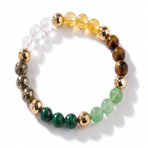
Certified & Energised
GemSense Dhan Yog Crystal Bracelet for Wealth & Financial Success
The reader-favourite place to start — five wealth stones on one wrist, SGL certificate in the box.
₹ 699₹ 1,399The traditional pyrite bracelet benefits are four: wealth, confidence, focus and protection from negativity. Pyrite — the golden, metallic mineral nicknamed "fool's gold" — has become India's most popular money stone because it keeps your prosperity intention visible on your wrist all day. Tradition ties it to action and self-belief; it does not print cash, and anyone promising that is selling hype, not stone.
Count the wrists in any Indian office, showroom or college canteen this year and you will spot it — a chunky golden bracelet catching the light. That is pyrite, almost certainly. In a few short years it has travelled from the mineral collector's shelf to the most asked-about crystal in the country, recommended by Vastu consultants, gifted at Diwali, and discussed in trading groups at 9:14 in the morning, one minute before the market opens.
Popularity brings noise. Half the internet claims pyrite will double your income by next quarter; the other half calls it a shiny rock for the gullible. The truth, as usual, is more interesting than either camp. In this guide we cover what pyrite actually is, why so many traditions tie it to wealth, its benefits life-area by life-area, who it suits and who should skip it, and how to make sure the piece on your wrist is real. We sell pyrite every single day — and we would still rather lose a sale than repeat a lie about it.
What Is Pyrite, Actually?
Pyrite is a natural mineral — an iron sulfide (FeS₂) — with a bold metallic lustre and a brass-gold colour so convincing that prospectors nicknamed it "fool's gold." It contains no actual gold, scores about 6–6.5 on the Mohs hardness scale, and often grows as perfect, glittering cubes straight out of the earth.
If you reached this page after searching "what is pyrite stone", here is the short science, minus the jargon. The name comes from the Greek pyr, meaning fire, because pyrite throws sparks when struck against steel — our ancestors lit fires with it, and early firearms used it to ignite gunpowder. According to Wikipedia's pyrite entry, it is the most abundant sulfide mineral on Earth, found on every continent. The bright, brassy bead variety that Indian sellers market as golden pyrite comes largely from Peru and Spain, with deposits in India as well. Mineral databases such as Mindat record its hardness at 6–6.5 — harder than window glass — which is why pyrite beads take daily wear surprisingly well. They have exactly one weakness, which most sellers forget to mention: moisture. Being an iron mineral, pyrite can slowly oxidise and darken if it lives in water or sweat. Keep it dry, and the golden shine stays for years.
Why Is Pyrite Called the Wealth Stone?
Pyrite earned its wealth reputation the honest way: it looks like gold. Across Vastu, Feng Shui and European folklore, a stone that resembles money has long been treated as a magnet for money. Modern wearers add a practical layer — a gold-coloured bracelet is a constant, glinting reminder of the financial goals you have set.
The tradition runs deeper than looks, though. Vastu practitioners keep raw pyrite near the cash counter, the account books or the office desk — the logic being that the stone's bold, fiery energy is believed to invite activity wherever money sits. Feng Shui assigns it to the wealth corner for the same reason. And in India, none of this feels like a stretch. In homes where a new scooter gets a nimbu-mirchi and a new shop opening gets a coconut, wearing a wealth stone on your wrist is simply the same instinct in a smaller size. Prosperity here is an open aspiration, not an awkward one.
There is also a plainly human reason the tradition persists. Money goals fail quietly — the unsent proposal, the payment nobody chased, the SIP paused "just for this month." A pyrite bracelet sits exactly where you look fifty times a day, and wearers consistently tell us its real power is that it never lets the intention go quiet. That is not magic. Honestly, it might be better than magic.
What Are the Benefits of Wearing a Pyrite Bracelet?
Traditionally, a pyrite bracelet is worn for four things: wealth and business growth, confidence and willpower, focus and discipline, and protection from negativity. None of them arrive automatically. The stone anchors a decision you have already made — to act bolder, stay steadier and guard your energy — and keeps that decision on your wrist.
That is the honest frame for every pyrite crystal benefit you will read below: tradition plus intention, never guaranteed outcomes. With that said, each of these four areas carries centuries of folklore and a very large number of modern wearers who swear by it. Let us take them one by one.
Wealth and Business
This is pyrite's home ground. Tradition links it to the courage to ask — for the order, for the raise, for the payment that has been "processing" since last month. Business owners and freelancers are our most loyal pyrite wearers, and the shift they describe is behavioural, not miraculous: quoting rates without apologising, following up without cringing, treating money conversations as normal conversations. A pyrite bracelet is the classic single-stone choice for this intention — bold, golden and impossible to ignore in the middle of a client call. The bracelet does not negotiate for you. It just makes it very hard to forget that you decided to negotiate. For a stone named after fire, that daily spark is the whole point.
Confidence and Willpower
In crystal tradition, pyrite is associated with the solar plexus — the energetic seat of personal power and self-belief. This is why wearers reach for it before interviews, pitches, appraisals and stage moments, the situations where you know your worth but your voice forgets it. People describe standing a little straighter, speaking a little earlier in the meeting, holding eye contact through the awkward salary pause. The framing matters here: pyrite is believed to amplify the confidence you are already building, not install confidence you have refused to build. Wear it as a badge of intent — the golden equivalent of writing "ask for what you are worth" on your own wrist — and let the interviews themselves do the proving.
Focus and Discipline
Pyrite's fiery reputation hides its quieter traditional role: grounding. Practitioners describe it as a stone of follow-through — the antidote to "from Monday" syndrome. That covers savings discipline, study timetables, gym streaks and the project sitting at ninety per cent since March. Students preparing for competitive exams tell us they like having one physical object that means focus when the phone means everything else; working professionals use it the same way through appraisal season. Again, seedhi baat: the stone reminds, but you still do the sitting-down part. A reminder you wear, though, is far harder to swipe away than one that pops up on a lock screen between two reels.
Protection from Negativity
Folk tradition across cultures treats pyrite as a shielding stone — its mirror-bright metallic surface was believed to deflect ill intent back towards the sender. In India this slots neatly beside the nazar instinct: the same reflex behind the black thread and the lemon on the bumper. Modern wearers translate it to the modern battlefield — office politics, backhanded compliments, that one relative's running commentary at every function. Framed honestly, wearing a protection stone will not change your colleagues or your relatives. But many wearers say it changes how much of the office they carry home in their chest, and that boundary — mine versus yours — is protection enough for most working days.
How Does Pyrite Compare to Citrine and Green Aventurine?
All three are classic wealth stones with very different personalities: pyrite pushes, citrine flows, aventurine opens. Pyrite drives action and bold asks; citrine — the old merchant's stone — is tied to retention and steady cash flow; green aventurine is tied to luck, timing and fresh opportunities. Many wearers eventually layer them rather than choose.
| Stone | Wealth Focus | How It Feels | Best For |
|---|---|---|---|
| Pyrite | Action, ambition and the confidence to ask | Bold, heavy, impossible to ignore | Business owners, freelancers, anyone whose bottleneck is hesitation |
| Citrine | Flow and retention — the merchant's stone of the cash box | Warm, light, optimistic | Shopkeepers and savers whose money arrives but never stays |
| Green Aventurine | Luck, good timing and new opportunities | Gentle, quiet, easygoing | Job seekers, students, fresh starts and new ventures |
If wealth is your primary goal and you want the full decision framework — including Tiger's Eye and the single-stone-versus-combination logic — our complete guide to the best crystal bracelet for money and wealth settles it properly. And if choosing one stone feels like choosing one hand, combination pieces like the Money Magnet bracelet and the Dhan Yog bracelet carry pyrite alongside citrine, green aventurine and tiger's eye in a single strand, so the stones cover each other's blind spots.
Who Should Wear Pyrite — and Who Shouldn't?
Pyrite suits people in an action phase: business owners, freelancers, sales professionals, job seekers and anyone tired of their own hesitation. Men and women wear it equally — tradition sets no gender rule. Skip it, or pace it, if bold energy feels overstimulating or what you actually want is calm.
The search data makes us smile: "pyrite bracelet for men" is one of India's most-typed crystal queries, as if the stone needed a gender permission slip. It does not. Yes, pyrite's chunky golden look sits beautifully on a broad wrist — it anchors our men's crystal bracelet collection for a reason — but women were wearing pyrite and marcasite jewellery a full century before Instagram discovered it. For a pyrite bracelet for women that feels lighter, slimmer bead sizes or a pyrite bangle frame the same stone with more elegance and the same tradition.
Who should think twice? Practitioners consistently describe pyrite as one of the more intense stones, so if your goal is softness, peace or emotional healing, a calmer crystal is usually the better first bracelet. A few wearers find any bold stone makes them restless in the first week — if that is you, wear it a few hours a day and build up slowly. And because no honest benefits article hides the flip side: pyrite side effects are real enough to deserve their own page, so we wrote one. Read our frank guide to pyrite bracelet side effects before you buy, not after.
How Can You Tell Original Pyrite From Fake?
Real pyrite is heavy for its size, cool to the first touch, and a pale brass-gold — never a bright, painted yellow. Look for tiny natural pits and facet-like glints instead of one uniform coating, and insist on independent lab certification. If a deal looks impossibly generous, it usually is.
The market's favourite trick is coated beads — glass, plastic or hematite dressed up in gold paint. Run your checks in this order. Weight: pyrite is dense, so a genuine strand feels heavier than it looks; fakes feel like costume jewellery. Temperature: real stone starts cool against the skin, while plastic is room-warm instantly. Colour: brass, not bling — natural pyrite has a slightly steely undertone, never a foil-bright yellow. Magnetism: pyrite does not snap to a fridge magnet; the "magnetic hematite" beads sold as pyrite do. Mineralogists also use the streak test — scraped on unglazed ceramic, pyrite leaves a greenish-black line while real gold leaves yellow — though we do not suggest scraping a finished bracelet you have already paid for.
The simplest protection, honestly, is paperwork. An original pyrite bracelet from a serious seller comes with independent lab certification — every GemSense piece ships SGL lab-certified, and our crystal certification page explains exactly what the lab checks. For the complete at-home checklist that works on any stone, not just pyrite, see our guide on how to check whether a crystal bracelet is real.
How Do You Wear and Care for Pyrite?
Wear pyrite on your left wrist to receive its energy, or shift it to the right on days you need to project confidence outward. Care comes down to one rule, repeated: keep it dry. Remove it before bathing and workouts, wipe it with a soft dry cloth, and store it away from moisture.
The left-wrist default comes from the traditional idea that the body's left side receives energy while the right side projects it — and since a wealth stone is about attracting, receiving is the point. Founders and salespeople often switch it to the right wrist on pitch days, to express the confidence rather than gather it. There is no penalty for choosing the "wrong" wrist; consistency and clear intention matter far more than geometry ever will.
On care, pyrite asks for less than most stones but is stricter about its one rule. As an iron sulfide, it can slowly oxidise — dulling or darkening — if it is regularly soaked in water or sweat. So the bracelet comes off before the shower, the pool, the gym and, if you can manage it, the monsoon commute. Skip the salt-water "cleansing" soaks the internet loves to prescribe; for pyrite specifically, water is the one thing to avoid. A few hours of moonlight, a pass through dhoop smoke or a quiet minute of intention-setting does the traditional job without touching the stone's surface. Stored dry and wiped after wear, golden pyrite keeps its metallic shine for years — and with this stone, the shine is rather the point.
Pyrite Bracelet FAQs
Is pyrite real gold?
No. Pyrite is iron sulfide (FeS₂) — the original "fool's gold" — and contains no usable gold, though natural pyrite ore sometimes carries invisible traces of it. You are buying the golden look and the wealth tradition, not the metal. Real gold is far softer and heavier.
Can women wear pyrite?
Absolutely. Crystal tradition sets no gender rule on pyrite — the wealth, confidence and focus associations apply to everyone. Women who find chunky 8mm beads heavy usually prefer slimmer strands or a bangle style. The stone does not check whose wrist it is sitting on.
Which hand should I wear a pyrite bracelet on?
The left wrist by default — tradition treats the left side as the receiving side, which suits a stone worn to attract wealth. Shift it to the right wrist on days you need to project confidence, like pitches or interviews. Consistency matters more than the choice.
Can I wear pyrite every day?
Yes — daily wear is exactly how most people use it, and intention works best with consistency. Just take it off for showers, swimming and sweaty workouts to protect the stone from moisture. If the bold energy ever feels like too much, give it a rest day.
Does pyrite rust or fade?
Its colour is natural, so it will not fade the way dyed beads do. But as an iron mineral, pyrite can slowly oxidise and darken with repeated exposure to water or sweat. Kept dry and wiped after wear, it stays bright for years.
Can I combine pyrite with rudraksha?
Yes — it is a well-loved pairing: rudraksha for spiritual discipline, pyrite for material action. Tradition sees no conflict between the two intentions. If you plan to stack further stones, our crystal bracelet combinations guide covers what pairs well and what to avoid.
So, Is a Pyrite Bracelet Worth Wearing?
If you want a stone that keeps your money intention loud, flatters every wrist it sits on, and carries the longest wealth tradition in the crystal world — yes, pyrite is the obvious first choice. There is a lovely irony in it: a mineral literally named fool's gold, worn daily by people who are anything but foolish about their goals.
The pyrite bracelet benefits that last are the ones you participate in. Buy it real, keep it dry, wear it with a clear intention — and do the work the stone keeps reminding you about. That combination is why pyrite wearers so rarely stop at one.
Crystals are a beautiful spiritual tradition, not medicine. They support your intentions — they don't replace effort or professional care.
Shop the crystals in this guide
Certified & Energised
GemSense Dhan Yog Crystal Bracelet for Wealth & Financial Success
The reader-favourite place to start — five wealth stones on one wrist, SGL certificate in the box.
₹ 699₹ 1,399Rose Quartz Bracelet Benefits: The Love Stone, Explained Honestly
Tiger Eye Bracelet Benefits: Courage, Focus & the Stone of Doers
Related Posts

Rudraksha Mala Guide: Japa Rules, 108 vs 54 vs 32 Beads & How to Spot an Original

5 मुखी रुद्राक्ष के फायदे: पंचमुखी रुद्राक्ष किसे और कैसे पहनना चाहिए

How to Wear a Pyrite Anklet: Which Leg, Which Day & the Rules That Matter

6 Mukhi Rudraksha Benefits: Kartikeya's Bead for Confidence, Focus & Expression


