

Tiger Eye Bracelet Benefits: Courage, Focus & the Stone of Doers
Certified & Energised
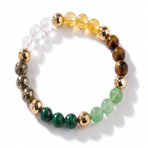
GemSense Dhan Yog Crystal Bracelet for Wealth & Financial Success
The reader-favourite place to start — five wealth stones on one wrist, SGL certificate in the box.
₹ 699₹ 1,399A tiger eye bracelet is traditionally worn for courage, confidence, focus and grounded decision-making — which is why it's called the stone of doers. In Indian practice it suits students before exams, professionals before interviews, and founders taking risks. The golden-brown, chatoyant quartz works as a daily reminder to act rather than overthink. Its benefits come from tradition and intention — not medicine.
Walk into any gym, startup office or coaching-class corridor in India and you'll spot it: a wrist of golden-brown beads with a band of light that seems to move when the arm does. Tiger's eye has quietly become the country's favourite "get things done" stone — worn by students, job-seekers, gym regulars, founders, and plenty of people who simply think it looks brilliant. (It does.)
But between reels promising overnight transformation and sellers pushing shiny resin lookalikes, it's surprisingly hard to get a straight answer about tiger eye bracelet benefits. What does the stone actually stand for? Who should wear it — and who should pause first? Which hand? And how do you tell an original from a fake that costs the seller almost nothing to make?
This guide answers all of it, honestly — the tradition, the practical care, and the parts nobody puts in the ad copy. No hype, no miracle promises. Let's start with the stone itself, because knowing what tiger eye is makes every other question easier.
What Is Tiger's Eye, Actually?
Tiger's eye is a golden-brown variety of quartz famous for chatoyancy — a silky band of light that glides across the stone when you tilt it, like a cat's eye catching torchlight. The bands form when fibrous minerals inside the rock are slowly replaced by quartz, leaving that signature striped shimmer.
The geology is genuinely lovely. Tiger eye stone began life as crocidolite — a fibrous blue mineral — that was gradually replaced by quartz over millions of years while keeping its silky, parallel fibre structure. Iron oxides stained those fibres golden to red-brown, and light reflecting off them creates the moving band gemmologists call chatoyancy, from the French oeil de chat, "cat's eye". If you enjoy the mineralogy, Wikipedia's tiger's eye entry covers the formation debate, and the parent mineral quartz has a full record on Mindat's mineral database.
Three practical facts matter for a bracelet buyer. First, tiger eye crystal is quartz, sitting around 7 on the Mohs hardness scale — gemological references such as the GIA's gem encyclopedia place that comfortably above everyday scratches, so it takes daily wear happily. Second, the best material comes largely from South Africa, with Australia and India producing it too. Third, that shifting golden band is nearly impossible to fake convincingly — which, as you'll see later, is your best friend when checking originality.
What Are the Benefits of Wearing a Tiger Eye Bracelet?
Traditionally, the benefits of tiger eye gemstone jewellery centre on four things: courage to act, steady focus, clearer decisions and grounding under pressure. In chakra terms it is linked to the solar plexus — the seat of willpower and self-belief. That's why tiger eye is nicknamed the stone of doers: it's worn to turn intention into action.
A quick honesty note before the list: none of this is magic, and none of it is medicine. A crystal works the way a vrat, a mannat thread or a kaala teeka works — as a physical anchor for an intention you've set yourself. With that clear, here's what tiger eye is traditionally worn for, and why each association exists.
Courage and Confidence
This is the big one — the reason tiger eye tops every confidence list. In folklore from ancient Rome to India, soldiers and travellers carried the stone for bravery and protection on the road. The modern version is less dramatic but just as real: the interview you keep postponing, the salary conversation you've rehearsed ten times, the client call, the stage, the first day at the new office. Wearers treat the bracelet as a physical cue — look down, breathe, walk in anyway. Our grandmothers would call it sher jaisi himmat; a psychologist would call it an anchor object. Both are describing the same gentle push.
It's especially loved by people whose work runs on nerve: founders pitching investors, freelancers quoting their real rate instead of the "safe" one, students facing a viva. The stone doesn't hand you courage — it reminds you that you already decided to be brave.
Focus and Discipline
Tiger eye's second reputation is as a focus stone — the one for people whose problem isn't ability but consistency. Exam aspirants preparing for boards, JEE, NEET or UPSC wear it through long study blocks as a "back to the book" reminder every time the phone starts whispering. Gym-goers use it exactly the same way: the bracelet goes on, the excuses go quiet, the session happens whether motivation showed up or not.
The traditional logic ties tiger eye to the solar plexus chakra, the energy centre associated with willpower and follow-through. The practical logic is simpler: discipline is mostly remembering, at 6 a.m. or 11 p.m., what you promised yourself last week. A band of golden stone on your wrist turns out to be a surprisingly effective string-around-the-finger for exactly that moment.
Clearer Decision-Making
Look closely at a tiger eye bead and you'll see light and dark bands sharing one stone. Tradition reads that as its personality: balance. Tiger eye is worn by people stuck between options — switch jobs or stay, expand the shop or consolidate, speak up or let it go — as a reminder to see both sides clearly and then choose, rather than orbiting the decision for months.
It's often called the stone of practical courage for this reason. Not recklessness, not paralysis — the middle path where you gather the facts, accept the risk and move. If your notes app is full of pros-and-cons lists that never end in an actual decision, this is the stone tradition would point you to.
Grounding and Steadiness
Courage stones can feel "hot"; tiger eye is valued because it pairs its push with earthiness. It's traditionally linked to the lower chakras as well — root and sacral — the older way of saying it keeps your feet on the ground while your ambition climbs. Wearers reach for it during high-pressure stretches: appraisal season, wedding-planning chaos, a startup's messy first year, results week.
The aim isn't to feel less — it's to stay steady while feeling it. Criticism lands, deadlines loom, and the intention tied to your wrist says: absorb, breathe, respond. If pure calm is what you're after, gentler stones like amethyst suit better; tiger eye is calm with a spine.
And here's what tiger eye won't do: it won't clear the exam, close the deal or lift the deadlift. No stone will. These are traditional associations that work through your own attention and belief — the bracelet is the reminder, you are the doer. That's not fine print to skim past; it is literally the point of the stone of doers.
Who Should Wear Tiger Eye — and Who Should Think Twice?
Anyone drawn to tiger eye can wear it — men and women, students and retirees; there are no gender rules. Traditionally it suits people chasing goals that need nerve and consistency. In jyotish-influenced circles, though, some advise those with certain rashis or strong Shani–Rahu influences to consult an astrologer first, since tiger eye is considered a Sun–Mars stone.
Start with who it suits. If any of these sound like you, tiger eye is a natural first pick:
- Students and aspirants who need daily study discipline more than motivational quotes
- Job-seekers and professionals facing interviews, appraisals or difficult conversations
- Founders, traders and freelancers whose week runs on bold-but-considered decisions
- Gym and sports people building consistency — tiger eye for men is so popular that it anchors our men's crystal bracelets collection, though women wear it in equal numbers
- Anyone rebuilding confidence after a setback, a layoff or simply a hard year
Now the "who should not wear tiger eye" part, told straight. In jyotish-influenced tradition, tiger eye is treated as a stone of Surya and Mangal — Sun and Mars energy. Because of the classical Sun–Saturn tension, some astrologers advise people with prominent Shani or Rahu placements — often mentioned alongside Tula (Libra), Makar (Capricorn) and Kumbh (Aquarius) rashis — to check before wearing it. Other practitioners disagree entirely and consider bead bracelets far milder than set gemstone rings, which is where most of those rules originated. There is no single rulebook here, and we won't pretend there is. If jyotish matters to you, ask your astrologer about your specific chart. If it doesn't, choose by intention and skip the worry — that's the honest answer. And if you're highly sensitive or easily overstimulated, you might simply find "driver" stones intense; gentler companions like rose quartz or amethyst may feel kinder to live with.
Which Hand Should You Wear Tiger Eye On?
Most Indian wearers put a tiger eye bracelet on the left hand — the receiving side in energy tradition — so its steadiness and self-belief flow inward through the day. Switch to the right hand on days you need outward projection: an interview, a pitch, a presentation. There's no hard rule; intention and consistency matter more than the wrist.
The fuller logic, if you want it: in Indian energy tradition the left side is the receiving channel, so a stone worn on the left keeps feeding its quality into your system quietly, all day. The right side is the giving or action channel, favoured when you must project confidence outward rather than gather it inward. Some jyotish practitioners prefer the right hand for Sun-linked stones like tiger eye; many modern wearers simply pick their non-dominant wrist so the beads don't knock the desk during work. All of these are conventions, not commandments — the wearers who report the most from their bracelet are the ones who picked one wrist, tied one clear intention to it, and stayed consistent. We've unpacked the whole left-versus-right question, including the giving/receiving tradition, in our guide on which hand to wear a crystal bracelet on.
How Do You Spot Real Tiger Eye?
Tilt the bead under light. Real tiger eye shows a chatoyant band — a ribbon of golden light that physically glides across the surface as the angle changes. Fakes made of glass, resin or printed stone have flat stripes that stay put. Real stone also feels cool, dense and scratch-resistant; resin feels warm and light.
Tiger eye original vs fake is one of the most-searched crystal questions in India, and for good reason — the market is flooded with lookalikes. The good news: tiger eye is one of the easiest stones to verify at home, because its defining feature cannot be painted on. Run these five checks:
- The tilt test (most reliable). Hold the bracelet under a phone torch and slowly roll it. On real tiger eye, the bright band glides across each bead like liquid light. On glass or resin, the stripes are frozen in place no matter how you turn it.
- The uniformity check. Natural beads are siblings, not clones — banding width, pattern and shade vary from bead to bead. Ten perfectly identical beads usually mean one mould.
- The temperature test. Hold the beads to your cheek: stone stays cool for a few seconds and feels dense for its size; resin warms instantly and feels suspiciously light.
- The colour check. Neon pink, green or turquoise "cat's eye" beads with one super-bright band are fibre-optic glass — pretty, but not tiger eye. Natural colour runs golden-brown to reddish; a blue-grey cousin (hawk's eye) exists, but it's muted, never neon.
- The paperwork. A genuine seller will happily provide independent lab certification. Every GemSense bracelet is SGL lab-certified — here's how our crystal certification works.
Want the full at-home routine, including how to do a scratch test without ruining your bracelet? Read our step-by-step guide on how to check whether a crystal bracelet is real.
Tiger Eye vs Pyrite vs Black Tourmaline: What's the Difference?
All three are "strength" stones with different jobs. Tiger eye builds courage and focus for action. Pyrite is the wealth-and-ambition stone, worn for money goals and hustle. Black tourmaline is the bodyguard — protection, grounding and nazar-blocking. Choose by your primary goal, or pair two if your goals genuinely overlap.
| Stone | Primary energy | Best for | How it feels day to day |
|---|---|---|---|
| Tiger's Eye | Courage, focus, willpower | Exams, interviews, gym discipline, bold decisions | A push — "get up and do it" |
| Pyrite | Wealth, ambition, opportunity | Business growth, sales targets, money mindset | A hunger — "go earn it" |
| Black Tourmaline | Protection, grounding | Blocking negativity, heavy environments, buri nazar | A shield — "stay steady" |
Overlapping goals are completely normal — plenty of people wear tiger eye for the interviews and pyrite for the business, or pair tiger eye's drive with black tourmaline's shield through a stressful quarter. Two bracelets sit happily together as long as their intentions don't argue; our crystal combinations guide covers which pairings work, which to skip, and how rudraksha fits in.
How Do You Cleanse and Care for It?
Cleanse a tiger eye bracelet every one to two weeks: rinse it briefly under plain running water, pat it dry, and recharge it in gentle morning sunlight for twenty to thirty minutes — fitting for a Sun-linked stone. Avoid perfume, harsh chemicals and long soaks, which dull the polish and weaken the elastic.
Tiger eye is one of the lowest-maintenance stones you can own. As quartz, it's hard enough for daily wear, doesn't mind sweat (just wipe it down after the gym) and won't suffer in water the way softer stones like selenite do. Still, a simple rhythm keeps the stone — and your intention — fresh:
- Weekly-ish cleanse: thirty seconds under plain running water, then pat dry. Skip soaps and salt-water soaks; they do nothing extra and are hard on the thread.
- Recharge: twenty to thirty minutes of soft morning sun, or overnight moonlight if you prefer. Avoid hours of harsh afternoon heat — it stresses the elastic more than the stone.
- Smoke works too: a few slow passes through dhoop or sandalwood incense is the classic Indian alternative when sunlight isn't practical.
- Protect the polish: take it off for swimming (chlorine is unkind), and apply perfume before wearing the bracelet, never over it.
- Store it solo: quartz is harder than many stones and will happily scratch softer bracelets sharing its pouch.
Timings, full-moon rituals and the complete do-not list are in our guide to cleansing and charging crystal bracelets.
Tiger Eye Bracelet FAQs
Can everyone wear a tiger eye bracelet?
In general practice, yes — there are no gender or age restrictions. The only caveat comes from jyotish, where some astrologers advise certain rashis (often Libra, Capricorn and Aquarius) to consult before wearing Sun–Mars stones. If astrology isn't your framework, wear it by intention.
Which hand is best for tiger eye?
Left hand for most people — the receiving side, letting confidence settle inward through the day. Right hand on days you need to project outward: interviews, presentations, negotiations. Neither is wrong; pick one wrist, set your intention and stay consistent.
Can women wear tiger eye?
Absolutely. Tiger eye gets marketed heavily to men, but the stone itself has no gender. Women wear it for the same reasons — courage in meetings, discipline in study, steadiness through career changes. Tradition qualifies it by rashi at most, never by gender.
Can I wear tiger eye with rudraksha?
Yes — many people in India wear both. Rudraksha carries devotional, calming energy while tiger eye adds worldly drive; wearers find they complement rather than clash. If you like symbolic tidiness, keep them on separate wrists and cleanse both regularly.
Does tiger eye fade over time?
Genuine tiger eye is colour-stable quartz — it won't fade with normal daily wear. Years of perfume, harsh chemicals or scorching sun can dull the polish slightly. If a bracelet visibly loses its colour within months, it was almost certainly dyed or fake.
What's the quickest real-vs-fake check?
The tilt test. Roll a bead under your phone torch: on real tiger eye the golden band glides across the surface as the angle changes. Flat motionless stripes, neon colours or a warm plasticky feel point to glass, resin or dyed imitations.
Tiger's eye has stayed loved for centuries without any marketing department — a stone that looks like bottled sunlight and quietly asks you to keep your word to yourself. If courage, focus or follow-through is what this season of your life needs, it's hard to pick a better companion. Choose a genuine, SGL lab-certified piece, put it on the wrist that feels right, tie one clear intention to it — and then go do the thing. When you're ready, explore our full range of confidence and strength bracelets, tiger eye included.
Crystals are a beautiful spiritual tradition, not medicine. They support your intentions — they don't replace effort or professional care.
Shop the crystals in this guide
Certified & Energised
GemSense Dhan Yog Crystal Bracelet for Wealth & Financial Success
The reader-favourite place to start — five wealth stones on one wrist, SGL certificate in the box.
₹ 699₹ 1,399Pyrite Bracelet Benefits: Why India's Wealth Stone Actually Works
Positivity Gemstones: 9 Energy-Shifting Crystals (India Guide)
Related Posts

Rudraksha Mala Guide: Japa Rules, 108 vs 54 vs 32 Beads & How to Spot an Original

5 मुखी रुद्राक्ष के फायदे: पंचमुखी रुद्राक्ष किसे और कैसे पहनना चाहिए

How to Wear a Pyrite Anklet: Which Leg, Which Day & the Rules That Matter

6 Mukhi Rudraksha Benefits: Kartikeya's Bead for Confidence, Focus & Expression


