

Which Crystal Bracelet Is Best for Money? Pyrite, Citrine or Dhan Yog
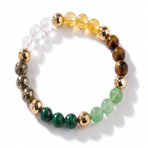
Certified & Energised
GemSense Dhan Yog Crystal Bracelet for Wealth & Financial Success
The reader-favourite place to start — five wealth stones on one wrist, SGL certificate in the box.
₹ 699₹ 1,399For most people, Pyrite is the traditional first choice for money — the classic golden stone of action, confidence and wealth energy. If you would rather not pick just one stone, combination bracelets like Dhan Yog and Money Magnet layer four wealth stones — Pyrite, Citrine, Green Aventurine and Tiger's Eye — into a single piece. The right pick depends on your goal: savings discipline, business growth or career luck. Here is exactly how to decide.
If you have ever typed "which crystal bracelet for money" into Google at 1 AM after a tight month, you are in very good company. Wealth is the single most common intention we hear about at GemSense — more than love, more than protection, more than everything else combined. And honestly, it makes sense. In our homes, prosperity has never been a guilty wish. We light diyas for Lakshmi ji every Diwali, we mark new account books with kumkum, we say "shubh labh" on the doorstep. Inviting abundance is culture, not greed.
But the wealth-bracelet market is noisy, and every second listing promises overnight riches. Seedhi baat: no bracelet prints money, and anyone who tells you otherwise wants yours. What a good wealth bracelet does — and does beautifully — is keep your money intention literally on your wrist, where you see it fifty times a day. This guide goes deep on the four classic wealth stones, explains what a Dhan Yog combination actually means, settles the pyrite vs citrine debate, and tells you which piece fits a salaried professional, a business owner or a student. No hype, promise.
Which Crystals Are Traditionally Associated with Money and Wealth?
Ask ten crystal advisors to name the best crystal for wealth in India and at least seven will say pyrite first — but the full traditional shortlist has four names: Pyrite, Green Aventurine, Citrine and Tiger's Eye. Each carries a different flavour of wealth energy, and knowing the difference is what separates a thoughtful choice from a random one. Let us meet them properly.
Pyrite — the Stone of Action and Confidence
Pyrite is where most wealth-bracelet journeys begin, and the reputation is earned. Its name comes from the Greek pyr, meaning fire — strike raw pyrite against steel and it literally sparks. Prospectors during the gold rushes nicknamed it "fool's gold" because its metallic golden glitter fooled them mid-river. The joke has aged rather well: today pyrite is loved precisely because it looks and feels like wearing small nuggets of gold on your wrist.
Traditionally, pyrite is associated with action, willpower and the confidence to ask — for the order, for the raise, for the payment that has been "processing" for forty days. Vastu practitioners often place a pyrite cluster near the cash drawer or office desk for exactly this reason. It is the stone of doing, not waiting. If you want one focused stone rather than a combination, a Pyrite bracelet is the classic single-stone starting point for wealth energy — simple, bold and very hard to ignore on your wrist.
Green Aventurine — the Stone of Luck and Opportunity
Green Aventurine is folklore's famous "gambler's stone" — old European tradition held that carrying it brought luck in games of chance. Its modern reputation is broader and much kinder: it is traditionally associated with opportunity, good timing and being in the right place when a door quietly opens. New job applications, a first client meeting, a fresh start after a setback — this is Aventurine's home ground.
Wearers often describe it as the gentlest of the four wealth stones. Where pyrite is believed to push, aventurine is believed to open. It rarely feels dramatic; it feels like things going a little more smoothly than they should. That quiet quality is exactly why nearly every serious wealth combination includes it — someone has to hold the door.
Citrine — the Merchant's Stone
Citrine, the warm honey-gold variety of quartz, carries the oldest shopkeeper tradition of them all. For generations, merchants across cultures kept a piece of citrine tucked inside the cash box, which is why it is still called the "merchant's stone". To an Indian ear this feels instantly familiar — the galla is not just a drawer in our tradition. It is worshipped at Diwali during Chopda Pujan, when account books are blessed for the new year. A citrine in the cash box is the same instinct, carried quietly through centuries of trade.
Traditionally, citrine is associated with keeping wealth flowing rather than merely arriving — steadier sales, fewer blockages, and a sunnier, less fearful money mindset. On the science side, the Gemological Institute of America (GIA) identifies citrine simply as the transparent yellow-to-orange variety of quartz, which is why genuine natural citrine glows soft honey rather than screaming neon orange. If a "citrine" bracelet looks like a traffic cone, walk away.
Tiger's Eye — the Stone of Focus and Clear Decisions
Tiger's Eye, with its silky golden-brown bands that shift in the light, is the thinker of the group. It is traditionally associated with focus, patience and clear-headed decision-making — holding your nerve through a negotiation, an appraisal discussion or a red-candle week in the markets. Folklore says Roman soldiers carried tiger's eye into battle for courage; modern wearers report reaching for it before interviews and investor pitches for the same steady, grounded feeling.
On its own, tiger's eye is really a career-and-courage stone more than a pure money stone. Inside a wealth combination, though, it is believed to play the most underrated role of all: discipline. Attracting ten opportunities means nothing if you cannot calmly choose the right one — and that judgment is tiger's eye's traditional department.
How Do the Four Wealth Stones Compare at a Glance?
Here is the entire shortlist side by side — screenshot this bit if you are the save-and-decide-later type. (We see you. We are you.)
| Stone | Traditional Wealth Association | Best For | Pairs Well With |
|---|---|---|---|
| Pyrite | Action, confidence and attracting prosperity; the classic wealth stone of Vastu and folklore | Business owners, freelancers, anyone who needs the push to ask and act | Citrine, Tiger's Eye |
| Green Aventurine | Luck, opportunity and good timing; the "gambler's stone" of old folklore | Job seekers, students, fresh starts and new ventures | Pyrite, Citrine |
| Citrine | The "merchant's stone" kept in cash boxes; flow, optimism and retained wealth | Shopkeepers, salaried savers, anyone whose money arrives but never stays | Pyrite, Green Aventurine |
| Tiger's Eye | Focus, courage and wise decisions under pressure | Negotiations, appraisals, interviews, investing decisions | Pyrite, Green Aventurine |
What Does "Dhan Yog" Actually Mean — and What Goes into a Dhan Yog Bracelet?
In Vedic astrology, a dhan yog is a wealth-forming combination in your kundli. It is not one lucky planet; it is an alignment. When the lords of the money houses — the 2nd house (dhan bhava, accumulated wealth) and the 11th house (labha bhava, gains and income) — connect favourably, often with benefics like Jupiter or Venus involved, astrologers say the chart "has dhan yog". The insight behind the term is old and rather wise: prosperity rarely comes from a single force. It comes from several forces agreeing with each other.
A Dhan Yog bracelet borrows that exact principle and translates it into stones. Instead of betting everything on one wealth crystal, it deliberately combines all four of the shortlist — citrine for flow, green aventurine for opportunity, tiger's eye for judgment and pyrite for action — so their traditional energies support each other the way well-placed planets are said to. Ours strings them as 8mm polished natural beads on a soft stretch cord, so the "yog" sits comfortably on any wrist, at a desk or at a puja thali.
The dhan yog bracelet benefits that wearers describe most often are not dramatic windfalls — they are alignment. The feeling that earning, saving and deciding have finally started pulling in the same direction instead of three different ones. If the layering idea appeals to you and you want to understand which stones sit well together (and which combinations to avoid), our crystal bracelet combinations guide goes into stacking logic in proper detail.
Which Crystals Are in a Money Magnet Bracelet — and How Do They Work Together?
Straight answer, because you may have searched "money magnet bracelet which crystals" and deserve one: a genuine Money Magnet bracelet contains Pyrite, Green Aventurine, Tiger's Eye and Citrine — the full wealth shortlist in one alternating-bead design. Ours uses 8mm natural polished beads of all four, with no dyed filler beads padding out the count. If a "money bracelet" somewhere online lists seven mystery stones and glitter, that is decoration, not tradition.
The easiest way to understand the combination is as a four-part engine:
- Pyrite is the ignition — traditionally linked to drive and the confidence to act on money matters today instead of "from Monday".
- Green Aventurine is the doors — associated with luck, timing and opportunities finding their way to you.
- Tiger's Eye is the steering — believed to keep decisions calm and focused, so you choose the right opportunity rather than every opportunity.
- Citrine is the fuel line — the merchant's stone, traditionally tied to keeping money flowing and the mood optimistic while you build.
The philosophy is simple and, we think, honest: money problems are rarely one problem. Hesitation, missed chances, impulsive calls and leaky retention usually travel together as a loop. A single stone speaks to one part of that loop; a combination speaks to the whole circuit. That is why the Money Magnet has quietly become our most-gifted bracelet — it does not assume anything about the wearer except that they want the full toolkit.
Pyrite vs Citrine: Which Is Better for Money?
The short, honest answer: pyrite for earning, citrine for keeping. They approach wealth from opposite directions, which is exactly why this comparison matters more than any other on this page.
Pyrite is the go-getter. Its traditional associations are all outward — ambition, boldness, asking, closing, following up. It suits people whose money problem is action: the proposal sitting unsent, the invoice unraised, the rate card that has not been revised since 2023 because raising prices feels awkward. Pyrite's heavy, metallic, gold-like presence on the wrist works like a daily nudge — wearers say it is very hard to undercharge while wearing a stone that looks like money.
Citrine is the flow-keeper. Its merchant's-stone tradition is all about what happens after money arrives — retention, circulation, cheerfulness around finances instead of anxiety. It suits people whose money comes in fine but never seems to stay: leaky weekend spending, stalled repeat sales, a habit of expecting the worst every time the bank SMS pings. Where pyrite is believed to open the tap, citrine is believed to fix the bucket.
So when people ask us to settle pyrite vs citrine for money, we answer with a question: is your bottleneck earning or keeping? Choose pyrite if you need courage and action. Choose citrine if you need flow and retention. And if your honest answer is "both, yaar" — that is not indecision, that is diagnosis. It is precisely why the Dhan Yog and Money Magnet combinations carry the two stones side by side, so you never have to choose one half of the equation.
Which Hand Should You Wear a Money Bracelet On?
Tradition answers this one clearly: the left wrist. In crystal practice, the left side of the body is considered the receiving side — energy is believed to flow inward through it — and since a wealth bracelet is about drawing abundance towards you, the left wrist is the default home for pyrite, citrine, aventurine and combination pieces alike. For most right-handed people this is convenient too, since the beads stay clear of writing, cooking and constant hand-washing.
One useful exception. If your work is outward-facing — sales calls, pitching, leading a team — some wearers shift tiger's eye or pyrite to the right (projecting) wrist on big days, to express confidence rather than receive it. Both approaches live happily inside tradition, and there is no penalty for choosing the "wrong" wrist; consistency and intention matter far more than geometry. For the complete left-versus-right logic, including the desi context of the right hand as the giving hand in shagun and daan, read our full guide on which hand to wear a crystal bracelet.
How Long Before You Notice a Shift?
Let us be the one crystal brand that says it plainly: a wealth bracelet is not a lottery ticket. If any seller promises you a jackpot in seven days, keeping your money in your pocket is the most abundant financial decision you will make that day.
What wearers traditionally report is quieter — and far more believable. In the first few days, the bracelet mostly works as a reminder: you feel it while typing, notice it while paying, and each glance re-runs your intention. Around the two-to-four-week mark, people commonly describe behavioural shifts — following up on pending payments faster, pausing before impulse buys, speaking up in the salary conversation they had been postponing. By around ninety days, the honest question worth asking is not "did money fall from the sky?" but "did my money behaviour change?" — and that is the shift wearers write to us about most.
Think of it the way you think of a kalava tied at a puja. Nobody believes the red thread does the work; it keeps the sankalp — the vow — warm on your wrist long after the ritual ends. A wealth bracelet supports intention and habit in exactly that way. The stone is the reminder. The earning, gloriously, remains yours.
Which Rituals Pair Well with a Wealth Bracelet?
Stones and rituals have always travelled together in India, and a few simple practices deepen the relationship with a wealth bracelet. None are compulsory. All are lovely.
- Cleanse it regularly. Wealth stones are worn daily through crowded markets, tense meetings and long commutes, and tradition holds that they absorb plenty along the way. A monthly reset — overnight in moonlight, or resting in a bowl of dry rice — is the gentle standard. One caution: pyrite contains iron and genuinely dislikes water, so skip long soaks. Our guide on how to cleanse a crystal bracelet covers every safe method stone by stone.
- Set the intention out loud. When the bracelet is new (and after every cleanse), hold it for a quiet minute and give it one specific sentence. "I follow up on every pending payment this month" beats "I want money" — vague intentions produce vague reminders.
- Use Fridays. Shukravar is Venus's day in the Vedic week and is widely devoted to Lakshmi ji. Many wearers re-set their intention on Friday mornings — a two-minute ritual that neatly bookends the working week.
- Mark Diwali and Dhanteras. These are the great wealth-intention days of the Indian calendar — the same days shopkeepers perform Chopda Pujan over the galla and account books. Many customers begin a new bracelet, or freshly cleanse an old one, at Dhanteras so the piece starts its year alongside everything else auspicious.
- Pair it with one money habit. Tradition and psychology hold hands here: attach the bracelet to a single concrete habit — a weekly expense review, one gratitude note for money received, one follow-up email — and let the wrist reminder trigger it. This is where wearers say the "magic" actually compounds.
Salaried, Business Owner or Student: Who Should Pick Which?
The goal is the same — barkat, that lovely word for wealth that grows and stays blessed — but the daily battles are different. Here is how we genuinely guide people when they write to us:
- Salaried professionals. Your money life runs on appraisal cycles, negotiations and savings discipline. Tiger's eye energy earns its keep in review meetings, and citrine's retention tradition suits the monthly-salary rhythm, where the challenge is keeping, not receiving. The Money Magnet, with both stones aboard plus pyrite's nudge for that overdue "can we discuss my compensation" email, is the balanced office all-rounder.
- Business owners and freelancers. Your battles are cash flow, receivables and bold pricing. Pyrite-forward is the traditional answer — it is the stone of asking and acting. If your world already includes Friday puja, muhurat timings and a worshipped galla, the Dhan Yog's Vedic framing will feel like home rather than novelty; it is the piece we most often send to shop counters and studio desks.
- Students and early careers. Internships, placements, first salaries — your wealth story is all doors. Green aventurine's opportunity-and-timing tradition fits this chapter perfectly, with tiger's eye as the interview-nerves companion. A single-stone piece is a sensible, wallet-friendly first bracelet; the combinations can come when the story gets more complicated. (It will. Enjoy this part.)
Still torn between two? Write to us at support@gemsense.in (Monday to Saturday, 9 AM–6 PM IST) — real humans, no pushy scripts, and we will happily talk you out of buying two when one is right.
Have More Questions About Money Bracelets?
Can I wear pyrite and citrine together?
Haan, absolutely — it is one of the most classic wealth pairings in crystal tradition. Pyrite brings the action-and-confidence energy while citrine brings the flow-and-retention energy, so they are treated as complementary, never conflicting. This is exactly why both our Dhan Yog and Money Magnet designs carry the two stones side by side on one cord.
Dhan Yog vs Money Magnet — what's the difference?
Both bracelets draw on the same four-stone wealth family: pyrite, citrine, green aventurine and tiger's eye. The difference is intention and framing. The Dhan Yog is designed around the Vedic idea of a wealth-forming yog — it suits wearers who connect with kundli, muhurat and puja traditions. The Money Magnet is the modern, goal-first expression of the same shortlist in an alternating-bead design. Choose whichever framing you will actually feel connected to every morning — that daily connection, not the label, is what does the work.
Is pyrite real, or is "fool's gold" a fake stone?
Pyrite is completely real — it is a natural iron sulfide mineral, documented in every mineralogy reference. "Fool's gold" only means it fooled gold prospectors with its metallic shine; it was never an insult to the stone itself. A genuine pyrite bracelet is 100% natural crystal, and every GemSense piece ships SGL lab-certified with its Certificate of Authenticity, so you know exactly what is on your wrist.
Which crystal is best for career growth and promotion?
Tiger's eye is the traditional first pick for career — focus, courage in difficult conversations and calm judgment are its home territory. Pair it with green aventurine if your goal is new opportunities (a role change, a transfer, a first job) rather than climbing where you already are. For an all-round career-plus-wealth intention, the four-stone combinations cover both fronts.
Can I wear my wealth bracelet all the time — even bathing or sleeping?
Daily wear is encouraged, but remove it for baths and swims: soap film dulls the polish, chlorine is unkind to most stones, and pyrite in particular contains iron and should stay dry. Sleeping in it is personal preference — many wearers keep the bracelet on the desk or near the cash box overnight instead, which sits nicely within the merchant's-stone tradition anyway.
Do money bracelets actually work?
Honestly? Not like a machine — like an anchor. The benefits described in this guide come from cultural and metaphysical tradition, not scientific proof, and no stone can replace effort, skill or sensible planning. What wearers consistently report is sharper focus on money goals, more confidence in money conversations and steadier money habits — because the intention sits on the wrist, in sight, all day. Your effort is the engine; the bracelet keeps it in gear.
Sources & Further Reading
- Gemological Institute of America (GIA) — Citrine: the authoritative gemological reference confirming citrine as the transparent yellow-to-orange variety of quartz, with history and quality factors.
- Encyclopaedia Britannica — Pyrite: the mineralogy of iron sulfide, its brass-yellow metallic lustre and the origin of the "fool's gold" nickname.
- Garuda Purana (Ratna Pariksha chapters): one of the classical Sanskrit sources for India's gem traditions, from which the navaratna and ratna-wearing culture descends.
Ready to Put Your Money Intention on Your Wrist?
If one stone called out to you while reading, trust that instinct — a single-stone piece worn with genuine intention beats a combination bought in confusion. But if you want the full shortlist working together, our two hero pieces are ready when you are: the Dhan Yog Bracelet, for wearers who want their wealth intention rooted in Vedic tradition, and the Money Magnet Bracelet, the modern four-stone stack for goal-first go-getters. Every GemSense bracelet is 100% natural crystal, SGL lab-certified, and arrives with its Certificate of Authenticity in the box — because trust, like wealth, compounds.
Disclaimer: The crystal benefits described in this article are based on traditional, cultural and metaphysical beliefs, and are shared as such — they are not scientific claims or guarantees of financial results. A crystal bracelet is a companion to your intention, effort and habits; it is never a substitute for professional financial advice.
Shop the crystals in this guide
Certified & Energised
GemSense Dhan Yog Crystal Bracelet for Wealth & Financial Success
The reader-favourite place to start — five wealth stones on one wrist, SGL certificate in the box.
₹ 699₹ 1,399How to Check if Your Crystal Bracelet Is Real: 7 Tests + Lab Proof
क्रिस्टल ब्रेसलेट के फायदे: कौन सा क्रिस्टल पहनना चाहिए?
Related Posts

Rudraksha Mala Guide: Japa Rules, 108 vs 54 vs 32 Beads & How to Spot an Original

5 मुखी रुद्राक्ष के फायदे: पंचमुखी रुद्राक्ष किसे और कैसे पहनना चाहिए

How to Wear a Pyrite Anklet: Which Leg, Which Day & the Rules That Matter

6 Mukhi Rudraksha Benefits: Kartikeya's Bead for Confidence, Focus & Expression


