

How to Check if Your Crystal Bracelet Is Real: 7 Tests + Lab Proof
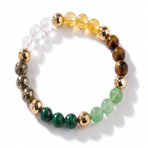
Certified & Energised
GemSense Dhan Yog Crystal Bracelet for Wealth & Financial Success
The reader-favourite place to start — five wealth stones on one wrist, SGL certificate in the box.
₹ 699₹ 1,399Let's start with the honest truth: a large share of the cheap "crystal" bracelets sold on Indian marketplaces are not crystals at all — they are coloured glass, resin, or white howlite dyed to look like something rarer. The good news? Seven simple home tests — temperature, hardness, bubbles, weight, colour zoning, sunlight fade and the bead-hole check — catch most obvious fakes. The conclusive answer, though, comes only from an independent gem-lab certificate that identifies your stone scientifically.
If you have ever held your new amethyst up to the light and quietly wondered, "is this asli or nakli?" — you are asking exactly the right question, and this guide was written for you. Maybe you bought it from a Diwali mela stall, maybe from a marketplace listing with suspiciously perfect photos, or maybe you are researching before you buy (smart move). Either way, by the end of this article you will know how to check if your crystal bracelet is original at home, understand what those tests can and cannot prove, and know exactly how laboratory certification settles the question for good. And if you are still deciding which stone to bring home in the first place, our guide on which crystal bracelet is best for you pairs beautifully with this one.
Why Are Indian Marketplaces Flooded With Fake Crystal Bracelets?
Because faking is easy, checking is rare, and the demand is enormous. Crystal bracelets have gone from a niche interest to a mainstream gifting item in India, and wherever demand runs ahead of knowledge, imitations follow. Most fakes you will encounter belong to one of three families:
- Coloured glass. Melted, tinted and moulded into perfectly round beads by the tonne. Glass is the number-one impostor for amethyst, rose quartz, citrine and aquamarine, because it can be tinted to any shade and polished to a convincing shine.
- Dyed howlite and magnesite. Howlite is a soft, chalky-white stone with grey veins that absorbs dye beautifully. Dyed sky-blue, it becomes "turquoise". Dyed deep blue, it plays "lapis lazuli". Dyed purple, it even impersonates amethyst. It is a real stone — just not the stone on the label.
- Resin and acrylic. Plastic, essentially — light as a toffee wrapper, warm to the touch, sometimes with glitter or foil mixed in to mimic sparkle. Much of the "cherry quartz" in the market is exactly this, and "opalite" sold as moonstone is man-made glass.
Here is the part we always insist on saying: not every seller is dishonest. Many small shops genuinely do not know what they are selling. They buy from a wholesaler, who bought from another wholesaler, and nobody in that chain has ever sent a single bead to a laboratory. The dye was applied three countries and four middlemen ago. That is precisely why "100% original, guaranteed" typed into a product description means nothing by itself. Proof is a process, not a promise — so let's learn the process.
And it matters more than it might seem. You wear this bracelet every day. You may have gifted one to your mother, your best friend, your new team member. Being told that glass is amethyst is a small lie that touches something personal — and you deserve better than that.
How Do You Check if a Crystal Bracelet Is Original at Home? The 7 Tests
One ground rule before we begin: no single home test is a verdict. Each test filters out one category of fake — resin, glass, dye — so run them together and let the pattern speak. None of them needs special equipment beyond a phone torch, a magnifying glass if you have one, and ten quiet minutes. Where a test could damage your bracelet, we will say so clearly, so you can decide whether to do it at all.
Test 1: The Temperature Test (Real Crystal Stays Cool)
Crystalline quartz conducts heat away from your skin far better than glass or plastic does — which is why a genuine crystal always feels a shade colder than the room, the way a brass door handle does on a winter morning in Delhi.
- Leave the bracelet on a table, away from sunlight, for 15–20 minutes so it settles to room temperature.
- Press two or three beads against your inner wrist or your cheek — the most temperature-sensitive skin you have.
- Read the result: real quartz feels distinctly cool and stays cool for several seconds before slowly warming. Glass feels cool for a moment, then quickly matches your body heat. Resin or acrylic feels warm almost instantly — like touching a plastic spoon.
What it catches: resin and plastic immediately, glass quite often. What it cannot prove: whether that cool stone is amethyst, dyed quartz, or a different mineral altogether.
Test 2: The Hardness Test (Quartz Sits at 7 on the Mohs Scale)
Amethyst and rose quartz are both varieties of quartz, which measures about 7 on the Mohs hardness scale. Ordinary window glass sits near 5.5, and a steel blade around 5.5 as well. The logic writes itself:
- A real quartz bead will scratch a piece of ordinary glass (an old bottle or a spare piece — never your phone screen) with light pressure, leaving a fine white line.
- A steel blade should not be able to scratch real quartz. If a knife tip leaves a visible mark on your "amethyst", it is not amethyst.
- Dyed howlite fails instantly here — at roughly 3.5 on the Mohs scale, even a copper coin can mark it.
A word of caution: this is a destructive test. If you must do it, choose one bead beside the knot, on the side that faces your wrist — or skip it entirely if the bracelet is dear to you. What it catches: glass, resin, howlite and other soft impostors. What it cannot prove: hardness alone cannot distinguish natural amethyst from lab-grown quartz, or from another equally hard stone.
Test 3: The Bubble Check (Round Bubbles Mean Glass)
This is our favourite five-minute test, because it needs nothing but your phone and a little patience.
- Switch on your phone torch and hold a bead directly against it so the light passes through.
- Look inside with a magnifying glass — or take a macro photo and zoom in on the screen.
- Perfectly round or oval air bubbles, or curved swirl lines, mean glass. Molten glass traps air as it cools; nature does not blow bubbles.
- Natural quartz shows a different inner world: cotton-like wisps, feathery veils, hairline fractures and angular mineral flecks — irregular shapes, never neat spheres.
Ironically, flawless emptiness is also a clue. A bead with absolutely nothing inside, sold at a throwaway price, is more likely glass or laboratory-grown material than a natural stone. Nature is beautiful, but she is rarely spotless. What it catches: most glass fakes. What it cannot prove: a bubble-free bead is not automatically natural.
Test 4: The Weight and Feel Test
Every mineral has a signature density — gemologists call it specific gravity — and your hand is a surprisingly decent scale once you know what to feel for.
- Rest the bracelet in your open palm and bounce it gently. Natural quartz has a satisfying, substantial heft for its size.
- Resin and acrylic feel toy-light. If a full bracelet feels like it weighs almost nothing, be suspicious.
- Pyrite is the opposite tell: real pyrite is dramatically heavy — nearly twice as dense as quartz. A "pyrite" bracelet that feels light in the palm is painted resin or coated glass, full stop.
Honest limitation: good-quality glass weighs almost the same as quartz, so this test alone cannot separate those two. Use it alongside the bubble and temperature checks, and treat it as the fastest way to expose plastic.
Test 5: The Colour-Zoning Check (The Amethyst Special)
If you remember only one thing about how to know if amethyst is real, remember this: natural amethyst is never one flat, uniform purple.
- Hold the beads up to daylight and rotate them slowly.
- Look for colour zoning — angular patches where deep violet softens into lilac, or even into clear and milky white. This is the fingerprint of how the crystal actually grew; the GIA notes that colour zoning is a common, characteristic feature of natural amethyst.
- Compare beads across the bracelet. Expect small, honest differences — one bead a shade lighter, another with a pale streak near the hole. Nature does not photocopy.
- Dyed glass and imitation beads are the same saturated grape-juice purple through and through, bead after identical bead. Perfect uniformity is the confession.
The same logic protects you with rose quartz — a soft, hazy, slightly uneven pink, never a loud bubble-gum uniform — and with banded stones like green aventurine, where natural sparkle sits unevenly inside the stone rather than painted across its surface.
Test 6: The Sunlight and UV Fade Test (Dye Always Confesses)
A mineral's own colour is part of its chemistry. Dye is a coat of borrowed colour — and borrowed colour does not survive the sun.
- This one is a slow observation rather than a same-day test: dyed stones worn daily often fade visibly within weeks, and they fade unevenly — patchy, washed-out beads next to darker ones.
- Quick version: moisten a cotton swab with acetone-based nail-polish remover and rub one bead near the knot for ten seconds. Colour on the cotton means dye. Test a single bead only, since acetone can dull some surface finishes.
- One fair warning so you don't panic later: even natural amethyst slowly pales after months of harsh, direct sunlight — it is a light-sensitive stone. That change is gradual and even, completely unlike dye's fast, blotchy fade. It is also why we recommend gentler cleansing methods for amethyst instead of sun-baking; our guide on how to cleanse your crystal bracelet walks through them.
Test 7: The Bead-Hole Check (Where Dye Tells On Itself)
The drill hole is the one place a factory cannot polish away the evidence. Take a magnifying glass — or your phone's macro mode — and inspect the holes closely.
- A darker ring of colour around the hole means dye pooled there while drying. This is the classic signature of dyed howlite and dyed quartz.
- White or pale material visible inside the hole means the colour is only skin-deep — dyed-howlite "turquoise" shows its white heart here every single time.
- Chipped or flaking colour at the hole's edge exposes coated glass or painted beads — very common with fake "pyrite" and metallic-finish beads.
- While you are there, check surface cracks too: dye loves to collect in fractures, leaving tell-tale dark threads running through the bead.
Real vs Fake Crystal Bracelet: How Do the 7 Tests Compare at a Glance?
| Test | Real crystal behaviour | Fake / glass behaviour |
|---|---|---|
| Temperature | Feels distinctly cool; warms slowly against skin | Glass warms within seconds; resin feels warm almost immediately |
| Hardness (quartz ~7 Mohs) | Scratches ordinary glass; a steel blade leaves no mark | Glass and howlite scratch easily; a blade marks the bead |
| Bubble check | Irregular wisps, veils, fractures and angular inclusions | Perfectly round air bubbles and curved swirl lines |
| Weight / density | Substantial heft; pyrite feels notably heavy | Resin feels toy-light; painted "pyrite" feels suspiciously light |
| Colour zoning (amethyst) | Uneven zones — violet fading to lilac or white; beads vary slightly | Flat, uniform purple across every identical bead |
| Sunlight / UV fade | Colour stable for months; any change is slow and even | Dyed beads fade fast and patchy; dye may wipe off with acetone |
| Bead-hole check | Colour runs consistently through the hole | Dye ring around the hole, white core inside, or flaking coating |
What Can Home Tests Prove — and What Can They Never Prove?
We would rather lose a sale than overstate a test, so here it is plainly. Home tests are excellent at catching the obvious impostors:
- They can catch: glass (bubbles, hardness, quick warming), resin and plastic (feather weight, instant warmth), dyed howlite and dyed quartz (bead-hole rings, patchy fading, colour on an acetone swab), and painted metallic beads (flaking at the drill holes).
- They cannot separate natural amethyst from lab-grown quartz. The two are chemically identical; telling them apart requires laboratory magnification of internal growth patterns.
- They cannot name a stone. Passing every test tells you your bead is a hard, cool, natural-looking crystal — not which crystal it is.
- They cannot detect every treatment. Heat treatment, subtle surface coatings and stabilisation are effectively invisible at home.
None of this is a reason for despair — it is simply the reason gem laboratories exist. Keep this line in your pocket: home tests filter; labs conclude.
How Do You Check Specific Stones? A Quick Stone-by-Stone Guide
Amethyst
Look for: uneven violet with angular colour zoning, a cool touch that lingers, and irregular wisps inside rather than round bubbles. Common fakes: purple glass (bubbles, flat colour, warms quickly) and dyed quartz (dye rings at the drill holes). Amethyst is the most bought — and therefore most copied — crystal in India, which is exactly why our amethyst crystal bracelet ships with its own SGL lab certificate, so you never have to squint and wonder.
Rose Quartz
Look for: a soft, hazy, almost misty pink. Natural rose quartz is rarely fully transparent — it carries a gentle internal cloudiness, and its colour sits unevenly through the stone. Common fakes: pink glass that is too clear, too bright and too uniform, often with visible bubbles. If it looks like pink lemonade poured into a bead, slow down and test it.
Pyrite
Look for: serious weight first — real pyrite is nearly twice as dense as quartz and feels unmistakably heavy and cold in the palm. Then the surface: a brassy metallic glint with tiny angular faces that catch light unevenly, sometimes with fine striations. Common fakes: gold-painted resin and coated hematite — both feel wrong in the hand, and the paint chips first at the bead holes. A genuine pyrite bracelet passes the weight test before it even reaches your eye.
Black Tourmaline
Look for: fine parallel striations — thread-like grooves running along the stone's length, which are tourmaline's natural signature — and a satiny sheen rather than a mirror-glass shine. Common fakes: black glass and dyed agate, both perfectly smooth and glossy. Obsidian, a natural volcanic glass, is also sometimes sold as tourmaline: a real material, but not the stone you paid for, and it lacks those characteristic grooves.
Turquoise
Deep breath here, because turquoise is widely considered the most faked stone in the world — gem traders joke that more "turquoise" is sold each year than the earth has ever produced. Look for: a waxy rather than glassy lustre, and irregular brown-to-black matrix veins that wander like river deltas — no two ever alike. Common fakes: dyed howlite and magnesite (veins too neat, too grey, white peeking out at the drill holes), reconstituted stone powder set in resin, and plain dyed ceramic. With turquoise more than any other stone, insist on laboratory identification — it is the entire reason our turquoise bracelet carries SGL documentation.
What Does a Gem Lab Actually Test? (The Science Behind the Certificate)
When a bracelet reaches a gemmological laboratory, nobody is holding it up to a torch and guessing. A trained gemologist measures physical constants — properties fixed by the stone's chemistry that no fake can imitate all at once.
- Refractive index (RI). A refractometer measures precisely how much the stone bends light. Quartz reads a tight 1.544–1.553 — a fingerprint. Glass reads differently, and unlike quartz it is not doubly refractive, a difference instruments spot instantly.
- Specific gravity (SG). The stone is weighed in air and again in water to calculate its exact density. Quartz lands at about 2.65 every single time; howlite and resin land clearly elsewhere, and even good glass rarely matches quartz exactly.
- Spectroscopy. A spectroscope reads which wavelengths of light the stone absorbs. Natural colouring agents and artificial dyes leave completely different absorption patterns — this is how a laboratory catches a dyed stone that sailed through every home test.
- Magnification and the polariscope. Under 10x–60x magnification, growth structures, inclusions and bubbles identify themselves to a trained eye. A polariscope separates crystalline quartz from amorphous glass in seconds.
Notice the asymmetry: no single home test survives all three impostors, but no impostor survives all four instruments. That, in one line, is the argument for certification.
What Does Your SGL Certificate Show — and How Do You Read It?
SGL (Solitaire Gemmological Laboratories) is an independent international gem-testing laboratory with facilities in India — the same category of institution that certifies diamonds and coloured gemstones for fine jewellers. When we talk about genuine crystal certification in India, this is the standard we mean: testing performed by a laboratory that has no stake in the sale. Independence is the whole point — the lab is paid to identify the stone, not to flatter it. Here is how to read the certificate that arrives with your GemSense bracelet:
- Report number. The unique ID of your certificate, and the anchor of the whole document — it can be verified with the laboratory directly (more on why that matters in the FAQs below).
- Item description. What was physically examined — for example, "one beaded bracelet". Match it against what is in your hand: bead count, bead size, overall weight.
- Identification. The verdict line — for example, "Natural Quartz, variety Amethyst." The word natural is doing the heavy lifting here: it rules out glass, resin and synthetic material in one stroke.
- Shape, dimensions and weight. Round beads, diameter in millimetres, total weight. Small variations from bead to bead are normal — welcome, even — in natural stone.
- Colour and comments. The observed colour and any disclosed treatments. Reputable labs state dye or stabilisation here openly; "natural" in the identification line with no adverse comments is what you want to see.
One clarity we always add: a certificate identifies the stone — species, variety, natural or not. It does not grade "energy" or blessings, because no laboratory on earth measures those. Anyone claiming a lab certified their bracelet's aura is selling poetry as physics — and we say that with affection, as people who love the poetry.
What Are the Red Flags When Buying a Crystal Bracelet Online?
Screenshot this list before your next late-night scroll-and-shop session:
- Machine-perfect beads. If every bead in the photo is pixel-identical in colour, pattern and clarity, you are probably looking at a mould, not a mine. Natural stone always varies a little.
- Prices that make no sense. Natural stone is mined, sorted, cut, polished, drilled, strung and certified — a long chain of real work. When a listing bundles "amethyst + citrine + full 7-chakra set" for less than what the courier charges to deliver it, the maths is telling you something.
- No certificate — or a dodge when you ask. Ask one question: "Which lab certified this, and what is the report number?" A genuine seller answers in one line. Vague "100% original" badges and evasive replies are decoration, not proof.
- "Energized" claims replacing authenticity proof. "Energised by pandit ji on purnima" may be a lovely sentiment — but it answers a question you did not ask. A blessing says nothing about whether the bead is quartz or glass. When spiritual claims are offered instead of identification, treat it as a flag, not a feature.
- Trade names that do not exist in mineralogy. "Cherry quartz" is glass. "Opalite" sold as moonstone or opal is man-made glass. If a stone's name draws a blank on serious gemology references, walk away.
- Stock photos and fading complaints. Read the low-star reviews specifically for the phrases "colour faded", "paint chipped" and "white inside" — earlier buyers have already run the tests for you.
Your Real-vs-Fake Questions, Answered
How do I know if my amethyst is real?
Run three quick checks. First, colour zoning: natural amethyst shows uneven violet with lighter angular patches — never one flat purple across every bead. Second, the torch test: round air bubbles inside mean glass. Third, temperature: real amethyst feels cool and stays cool noticeably longer than glass. Passing all three is a very good sign — but only a laboratory report reading "natural quartz, variety amethyst" is conclusive.
Is an expensive crystal bracelet always real?
No — and this answer matters. Price signals a seller's confidence, not a stone's identity. Plenty of dyed and glass bracelets are sold at premium prices in premium packaging, especially once words like "imported", "rare" or "AAA grade" appear on the box. The reverse is also true: an honest seller with low overheads can sell genuine stone very reasonably. The only combination that proves anything is stone plus independent certificate. Judge the paper, not the price tag.
Can a shop fake a certificate?
Sadly, yes — paper is easy to fake; science is hard to fake. Which is why the golden rule is verify, don't just receive: take the report number printed on the certificate and check it with the issuing laboratory directly — SGL, for instance, supports report verification through its own website. A certificate that cannot be verified with the lab that supposedly issued it is just well-designed stationery. Any genuine seller will welcome you checking. We actively encourage it.
If my bracelet fails one home test, is it definitely fake?
Not necessarily — and it is important to be fair here. A stabilised natural stone may release a whisper of colour on an acetone swab; a small-beaded quartz bracelet can feel lighter than you expected; a warm room can blunt the temperature test. Fail one test: investigate further. Fail three: you have your answer. And remember the reverse is equally true — passing all seven still is not laboratory proof.
Which crystals are faked the most in India?
By sheer volume, amethyst and the ever-popular "7-chakra" sets — simply because they sell the most, and glass imitates them cheaply. By reputation, turquoise is the most imitated stone in the world, with dyed howlite doing most of the impersonating. Also on the watchlist: rose quartz (pink glass), citrine (often heat-treated amethyst sold without disclosure) and moonstone (frequently opalite, a man-made glass).
Is a brand box or a bill proof that a crystal is real?
No. A bill proves a transaction happened; a box proves someone owns a printer. The only document that speaks about the stone itself is a gem-laboratory identification report. When you buy, keep that certificate as carefully as the bracelet — it is the piece of paper that answers every future question, from resale to simple peace of mind.
Sources & Further Reading
- GIA (Gemological Institute of America) — the amethyst entry in GIA's gem encyclopedia, including quality factors and colour zoning in natural amethyst: gia.edu/amethyst
- IGI (International Gemological Institute) — how independent laboratories examine and report on coloured gemstones: igi.org
- International Gem Society (IGS) — practical identification guides covering quartz varieties and their glass imitations: gemsociety.org
The GemSense Promise: Never Wonder Again
Our position is simple: you should not need a gemology degree to buy a bracelet with confidence. That is why every GemSense bracelet ships with an independent SGL lab certificate — the stone is identified scientifically before it ever reaches your wrist, and you can verify the report yourself, directly with the lab. Run the seven tests on our beads too; we genuinely encourage it — the cool touch, the zoning, the honest little variations from bead to bead will all be there. Then see exactly how our process works on our crystal certification page. Because trust, like a good crystal, should be able to survive close inspection.
The three most-doubted stones in India
Certified & Energised
GemSense Dhan Yog Crystal Bracelet for Wealth & Financial Success
The reader-favourite place to start — five wealth stones on one wrist, SGL certificate in the box.
₹ 699₹ 1,399Pyrite Bracelet Side Effects: Who Should and Shouldn't Wear Pyrite?
Which Crystal Bracelet Is Best for Money? Pyrite, Citrine or Dhan Yog
Related Posts

Rudraksha Mala Guide: Japa Rules, 108 vs 54 vs 32 Beads & How to Spot an Original

5 मुखी रुद्राक्ष के फायदे: पंचमुखी रुद्राक्ष किसे और कैसे पहनना चाहिए

How to Wear a Pyrite Anklet: Which Leg, Which Day & the Rules That Matter

6 Mukhi Rudraksha Benefits: Kartikeya's Bead for Confidence, Focus & Expression


