

Pyrite Bracelet Side Effects: Who Should and Shouldn't Wear Pyrite?
Certified & Energised
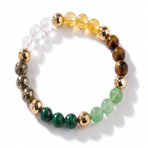
GemSense Dhan Yog Crystal Bracelet for Wealth & Financial Success
The reader-favourite place to start — five wealth stones on one wrist, SGL certificate in the box.
₹ 699₹ 1,399Seedhi baat: a pyrite bracelet is safe for most people to wear. The "side effects" people describe — restlessness, disturbed sleep, feeling over-charged — are about energy mismatch in traditional belief, not physical harm. There is exactly one real material caution: pyrite is iron sulfide (FeS₂), so keep it out of water, never inhale dust from a broken stone, and expect mild tarnish with heavy sweat. Everything else is manageable with a few simple rules.
If you've landed here after a late-night scroll through Quora threads and WhatsApp forwards — "pyrite gave my cousin headaches", "golden stone brought bad luck" — take a breath. We've helped thousands of wearers across India choose their crystals, and pyrite questions are the ones we hear most, especially around Diwali and the start of every new financial year. So instead of brushing your worries aside the way most blogs do, let's walk through the honest benefits and disadvantages of a pyrite bracelet, one by one.
By the end, you'll know exactly what wearers report, what science actually says about wearing iron sulfide on your wrist, who pyrite traditionally suits, who is advised to give it a miss, and the simple pyrite bracelet rules that keep the whole experience positive.
What Side Effects Do People Report From Wearing a Pyrite Bracelet?
Let's start with what wearers actually describe, because dismissing these experiences helps nobody. Across our customer conversations and the wider Indian crystal community, the same handful of reports come up again and again:
- Restlessness, or feeling "over-charged". Pyrite is traditionally considered one of the most energising stones you can wear — its very name comes from the Greek pyr, meaning fire, because it throws sparks when struck against steel. New wearers sometimes report feeling wired or extra-driven in the first week or two.
- Lighter sleep. Wearers who keep the bracelet on overnight, or park it on the bedside table, often say their sleep felt shallow or their mind stayed busy. In traditional framing, you've essentially worn an espresso to bed.
- A mild headache or "heavy" feeling at first. Some people describe a short adjustment period with strong stones. Believers call it too much fire energy too fast; sceptics call it coincidence. The practical fix is the same either way — shorter wear, slower start.
- Irritability. People who already run hot-tempered occasionally say pyrite turned the volume up. Traditionally, pyrite is mapped to Surya and Mangal — Sun and Mars energy — which is wonderful for drive and less wonderful for patience.
- Darkish marks on the wrist. This one is real and physical, and we'll unpack it properly below: sweat can slowly tarnish pyrite's metallic surface, and that film can leave a faint grey-green mark on the skin. It washes off with soap. It is not "toxins leaving your body", whatever Instagram claims — and it is not the stone "rejecting" you either.
Now notice what's missing from this list: nothing about ruined luck, failed businesses or frightening health effects. In classical jyotish, pyrite isn't even part of the navratna system — the nine gems that come with strict wearing rules and testing periods — so the dramatic "suits you or destroys you" folklore attached to stones like neelam simply doesn't apply here. Almost every reported side effect is the signature of an energising stone worn a little too enthusiastically. And every single one has an easy fix.
Is Pyrite Scientifically Dangerous to Wear?
Short answer: no — worn dry, polished pyrite is stable and safe. This is the section most blogs skip, so let's do it properly. Victorians wore pyrite jewellery for decades (sold under the name "marcasite"), and museums hold pyrite pieces that are centuries old. Solid, polished pyrite resting against dry skin poses no known hazard. Unlike cheap fashion jewellery, pyrite also contains no nickel — the metal behind most jewellery rashes — so genuine skin reactions to the stone itself are rare.
Pyrite fact-file: composition iron disulfide (FeS₂); Mohs hardness 6–6.5; specific gravity around 5 (noticeably heavy); metallic lustre; greenish-black streak; named from the Greek pyr (fire).
That said, pyrite has three genuine material quirks, and respecting them is what separates an informed wearer from a disappointed one:
- Water and prolonged moisture. When pyrite stays wet, its iron and sulfur slowly oxidise — mineral conservators literally call it "pyrite decay". On a bracelet, this shows up as dulling, dark tarnish and, over years of neglect, a rougher surface. One splash won't ruin anything; daily showers, swimming sessions and soaked monsoon sleeves will. Keep it dry.
- Dust from a broken stone. Sulfide mineral dust is a lung irritant and should never be inhaled. You will never meet this dust in normal wear — it only matters if a bead shatters or starts crumbling. If that happens, don't sand, drill or crush it; collect the fragments with a damp cloth, discard them, and retire that bead.
- Never for elixirs or gem water. Pyrite soaked in water can release iron and sulfur compounds — including traces of sulfuric acid — into it. Pyrite is a wear-it stone, never a drink-it stone. No pyrite-infused water, no pyrite in the bath, ever. Whatever a reel told you, please don't.
And the sweat question, since we promised honesty: sweat is salty moisture, so heavy gym sessions and peak-May afternoons can slowly tarnish the surface, occasionally leaving that faint washable mark on the skin. It's cosmetic, not toxic. If you ever notice persistent redness or itching under any bracelet, take it off and let the skin settle — in our experience the culprit is usually the elastic cord or metal spacers rather than the pyrite itself.
Worried About a Specific Side Effect? Here's the Truth at a Glance
Here's the whole article in one honest table — the common concern, what's actually happening, and what to do about it.
| The concern | The honest truth | What to do |
|---|---|---|
| "Pyrite makes me restless / I can't sleep" | Traditionally accurate — pyrite is an energising, fire-element stone, not a calming one | Wear it in the daytime only; remove it an hour before bed and keep it away from your bedside |
| "I felt a headache or heaviness at first" | Some wearers report a brief adjustment period with strong stones | Start with 2–3 hours a day for the first week, then build up; pair it with a grounding stone like Tiger's Eye |
| "There's a dark mark on my wrist" | Real but harmless — sweat slowly tarnishes iron sulfide, leaving a washable film | Wash the skin with soap, wipe the beads dry after sweaty days, wear it slightly loose in summer |
| "My bracelet went dull after the gym / monsoon" | True — moisture oxidises pyrite's metallic surface over time | Remove it before showers, swims and workouts; store it with a silica gel sachet in humid months |
| "Pyrite brings bad luck to some rashis" | No classical basis — pyrite is not a navratna gem, and jyotish assigns it no strict prohibition | Choose by intention; if astrology matters to you, begin with short daily wear and let experience decide |
| "Pyrite is toxic to wear" | Polished pyrite is safe on dry skin; the only real risks are inhaling dust from a crushed stone and drinking pyrite-soaked water | Never make pyrite elixirs; replace any bead that cracks or crumbles |
That's the entire "pyrite bracelet side effects" story in plain words: an energising stone can over-energise, and iron sulfide dislikes water. Everything else you've read is noise.
Who Should Wear Pyrite (Traditionally)?
Pyrite has been called the stone of the self-made, and tradition places it at the solar plexus chakra — Manipura, your seat of willpower and confidence. Its golden shimmer has long been linked with Lakshmi-energy and abundance, which is exactly why it flies off our shelves before Diwali. Traditionally, pyrite is considered a natural match if you see yourself here:
- Business owners and side-hustlers. Pyrite is the classic "money magnet" stone, traditionally believed to attract opportunity and steady a founder's nerve through the slow months.
- Sales, marketing and target-chasing professionals. Wearers report reaching for it before pitches, negotiations and appraisal conversations — it's worn as liquid confidence for the wrist.
- Students who need drive, not calm. For discipline and daily showing-up during long preparation seasons. (For exam-night nerves and sleep, tradition points to gentler stones — that's Amethyst's department.)
- Anyone rebuilding after a setback. A business that stumbled, a job that ended, a plan that needs restarting — pyrite is traditionally the stone you wear while you get your fire back.
- People who feel financially "stuck". Not as a lottery ticket, but as a daily wrist-level reminder that abundance is something you invite and work for.
If that sounds like your season of life, a genuine, SGL lab-certified pyrite bracelet is the simplest way to wear this intention daily — one stone, one clear goal. And as we always say at GemSense: the stone supports the intention, but the work is still yours. Pyrite won't deposit money in your account. What wearers say it does is subtler and, honestly, more useful — it keeps you bold enough to ask for what you're worth.
Who Should Not Wear Pyrite (Traditionally Speaking)?
Nobody is banned from pyrite — remember, there is no classical prohibition — but tradition does flag a few genuine mismatches. This is the part most sellers won't tell you, so read it twice:
- If your main goal is calm, peace or better sleep. This is the big one. Pyrite is an energising stone; asking it for shanti is like asking a dhol player for a lullaby. If this is a stress-heavy chapter of your life and what you really crave is rest and a quieter mind, tradition points you to softer stones first — Amethyst, Rose Quartz, Moonstone — and suggests saving pyrite for a more ambitious season.
- If you already run hot-tempered or restless. Modern advisors map pyrite to Sun-and-Mars fire. Wearers who are quick to anger sometimes find it amplifies the heat. If that's you, either give it a miss or balance it with a grounding partner — more on pairing below.
- Light sleepers. You can absolutely enjoy pyrite by day. Just don't sleep in it, and don't store it within arm's reach of your pillow.
- Rashi considerations, handled honestly. You'll read online that water-sign rashis — Kark (Cancer), Meen (Pisces) — must avoid pyrite, or that it "clashes with Shani". Here's the truth: pyrite sits outside classical jyotish altogether, so these are modern interpretations, not shastra. Some advisors do suggest gentler stones for water-dominant or peace-seeking charts, simply because pyrite's fire can feel like too much. If astrology matters to you, treat this as a comfort-fit question, not a fear question — start with a few hours of daytime wear and let your own experience be the judge.
- Very young children. Not for any energy reason — simply because small beads and small mouths don't mix, and pyrite must never be chewed or swallowed.
One more gentle observation from years of matching people to stones: if you're hesitating over this list, the hesitation itself is information. It usually means what you need right now is steadiness, not fire — and there's no shame in choosing the gentler stone first and returning to pyrite when your goals turn outward again.
Which Hand Should You Wear a Pyrite Bracelet On — And What Are the Rules?
The pyrite bracelet rules are short enough to memorise over one chai break:
- Left hand to receive. In Indian crystal tradition, the left side is the receiving side — wear pyrite on the left wrist to draw abundance inward. This is the default we suggest to most wearers.
- Right hand to project. The right is the action side. Shift the bracelet there on days you need to project confidence outward — presentations, client meetings, interviews, negotiations.
- Daytime is pyrite time. Wear it through your working hours and take it off by evening. Fire stones and pillows don't mix.
- Keep it dry. Off before showers, swims, gym and getting drenched in the rain — a material rule, not a spiritual one.
- Set one clear intention. The first time you wear it, hold it for a moment and name what you're inviting — one thing, said plainly. Vague wishes get vague results.
- Give it three to four weeks. Judge nothing in three days. Consistent wear, one intention, then review.
The left-versus-right question deserves more nuance than one bullet — including what to do if you wear a watch, and when tradition says to switch. Our full guide on which hand to wear a crystal bracelet on walks through all of it.
What Should You Pair a Pyrite Bracelet With?
Pairing is where most pyrite "side effects" quietly dissolve. If pyrite alone feels like one espresso too many, the traditional answer isn't to abandon it — it's to balance it:
- Green Aventurine — the classic wealth pairing. Traditionally the stone of luck and new opportunities, aventurine brings a gentle, heart-centred energy that rounds off pyrite's sharp ambition. Together they're India's favourite money duo: pyrite supplies the drive, aventurine the open doors.
- Tiger's Eye — the grounding partner. If you love pyrite's promise but worry about restlessness, Tiger's Eye is the traditional stabiliser: patient, focused, earthy. Wearers who felt over-charged by pyrite alone often settle beautifully with this combination.
- Citrine — sunshine with a smile. Another golden stone of abundance, traditionally softer and more cheerful than pyrite's boardroom energy. A lovely trio with the two above if you like a fuller stack.
Two stacking rules keep things clean. First, keep the intention coherent — wealth plus grounding works beautifully, while wealth stones stacked with deep-rest stones send your wrist mixed signals. Second, keep pyrite to one bracelet on one wrist rather than doubling it — one fire is plenty.
How Do You Care For a Pyrite Bracelet?
Pyrite care is ninety percent one word: dry. Here's the routine that keeps the golden shine for years:
- Daily habit. Slip it off before bathing, swimming, washing dishes and workouts. After a sweaty day, give the beads a quick wipe with a soft, dry cloth before putting the bracelet away.
- Cleaning. If it needs more than a wipe, use a barely-damp cloth and dry the beads immediately. Never soak it, and never give it the salt-water bath you've seen recommended online — that advice belongs to other stones; for pyrite it's the express train to tarnish.
- Energetic cleansing, without water. Tradition offers plenty of dry methods: rest it overnight on a selenite charging plate, leave it a few hours in moonlight on the windowsill, or pass it through loban or sage smoke. Full-moon nights are the classic monthly reset.
- Charging. A few minutes of gentle morning sun is traditionally welcome for this solar stone — ten minutes, not an afternoon on the parapet.
- Monsoon tip. July to September, store it in a closed pouch with a small silica gel sachet (rescue one from any shoebox). Indian humidity is pyrite's slowest, sneakiest enemy.
If the surface has already dulled from past soakings, don't panic — the bracelet is still perfectly wearable. Keep it dry from today, cleanse it on selenite instead of water, and the story ends there.
Real vs Fake Pyrite: How Do You Know Yours Is Genuine?
Here's an uncomfortable truth about the Indian market: a lot of "pyrite" being sold has never seen a mine. The most common fake is golden glitter resin — plastic beads loaded with sparkle powder, sold on railway platforms and reels alike. You'll also meet gold-painted glass and, occasionally, magnetic "golden hematite" passed off as pyrite. Real pyrite gives itself away in five honest tells:
- Weight. Pyrite is dense — its specific gravity is around 5, roughly double that of glass — so a genuine bracelet feels noticeably heavy for its size. A feather-light "pyrite" bracelet is telling you something.
- Temperature. Real pyrite feels cool the moment you pick it up and warms slowly, like metal. Resin feels room-temperature instantly.
- Looks. Genuine beads show uneven metallic flash — brass-gold with tiny pits, natural texture, sometimes faint striations. Fakes sparkle uniformly, like craft glitter, because that is literally what they contain.
- Hardness. At 6–6.5 on the Mohs scale, pyrite can't be scratched by a fingernail. Many resins can.
- The tarnish irony. Real pyrite can dull slightly over years of wear; glitter resin never will. The very "flaw" people worry about is actually a signature of authenticity.
The surest route, though, is independent certification. Every GemSense pyrite piece is SGL lab-certified — a recognised gem laboratory verifies the material is natural pyrite before it ever reaches your wrist, so you're never relying on eyesight and hope. For a stone whose entire symbolism is about real value versus fool's gold, wearing an uncertified one is an irony nobody needs.
FAQs: Pyrite Bracelet Side Effects and Rules
Who should not wear a pyrite bracelet?
Physically, almost nobody needs to avoid pyrite — worn dry, it's a safe stone. Traditionally, it's considered a mismatch for people whose main need right now is calm, deep rest or a quieter mind, for the very hot-tempered, and for anyone unwilling to take it off at night. Small children shouldn't wear it for simple bead-safety reasons. Everyone else is cleared for take-off.
Are pyrite bracelet side effects different for women?
No. Tradition doesn't gender pyrite — the abundance-and-confidence symbolism applies equally to everyone, and the material behaves identically on every wrist. The only practical differences are bead size and fit. Any page promising special "pyrite side effects for females" is filling space, not sharing knowledge.
Can I sleep wearing my pyrite bracelet?
Traditionally, no — pyrite is an energising stone, and most reported side effects (light sleep, a busy mind) trace straight back to overnight wear. Take it off an hour before bed and store it beyond arm's reach. Let your mornings be golden without your nights paying for it.
What happens if my pyrite bracelet gets wet?
One splash or a caught-in-the-rain moment: pat it completely dry and all is well. Repeated soaking is the real problem — iron sulfide oxidises with prolonged moisture, so daily showers or swims will slowly dull and tarnish the beads. A dulled bracelet is still wearable; just keep it dry from here on and cleanse it on selenite or in moonlight rather than in water.
Can I wear pyrite with Rudraksha?
Yes — and it's a much-loved combination in India. Rudraksha carries steady, sattvic energy; pyrite carries worldly drive. Worn together — say, the mala for your practice and the bracelet for your work — tradition sees them as balancing ambition with groundedness. There's no prohibition; just remember pyrite's keep-it-dry rule still applies to the bracelet.
How long before I feel anything from a pyrite bracelet?
Give it three to four weeks of consistent daytime wear before judging — the same patience we suggest with any crystal. Many wearers report the shift shows up in behaviour first: speaking up sooner in meetings, following through on the plan, quoting the price they actually want. The stone reminds; you act.
Sources & Further Reading
- Mindat.org — Pyrite: the reference mineralogy database entry covering pyrite's composition (FeS₂), hardness, streak and oxidation behaviour.
- Geology.com — Pyrite ("Fool's Gold"): an accessible overview of pyrite's physical properties, why it tarnishes, and how it differs from real gold.
- Gemological Institute of America (GIA): for how professional gem laboratories identify and test natural stones — the same discipline behind independent lab certification.
Ready to Wear Pyrite the Honest Way?
Here's the takeaway we hope stays with you: pyrite's "side effects" are mostly a strong stone meeting an unprepared routine. Wear it by day, keep it dry, start slow, pair it wisely — and it becomes exactly what tradition always promised: a small golden push, worn on the wrist, towards the life you're building. If pyrite's fire feels right for this chapter, you know where to find it. And if you're still torn between pyrite and something gentler, our two-minute Find Your Crystal quiz will match your mood and goals to the stone that fits this season of your life. No pressure, no drama — just the right stone, honestly chosen.
Crystals and Rudraksha are part of spiritual and cultural tradition, not medicine. The traditional benefits described in this article reflect widely held metaphysical beliefs and wearer experiences, not scientific proof, and are never a substitute for professional medical, psychological or financial advice. The guidance on water, moisture and dust, however, reflects pyrite's real material properties — please follow it whatever you believe.
Shop the crystals in this guide
Certified & Energised
GemSense Dhan Yog Crystal Bracelet for Wealth & Financial Success
The reader-favourite place to start — five wealth stones on one wrist, SGL certificate in the box.
₹ 699₹ 1,399Which Crystal Bracelets Can You Wear Together? Combos That Work
How to Check if Your Crystal Bracelet Is Real: 7 Tests + Lab Proof
Related Posts

Rudraksha Mala Guide: Japa Rules, 108 vs 54 vs 32 Beads & How to Spot an Original

5 मुखी रुद्राक्ष के फायदे: पंचमुखी रुद्राक्ष किसे और कैसे पहनना चाहिए

How to Wear a Pyrite Anklet: Which Leg, Which Day & the Rules That Matter

6 Mukhi Rudraksha Benefits: Kartikeya's Bead for Confidence, Focus & Expression


