

Positivity Gemstones: 9 Energy-Shifting Crystals (India Guide)
Certified & Energised
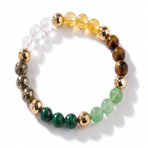
GemSense Dhan Yog Crystal Bracelet for Wealth & Financial Success
The reader-favourite place to start — five wealth stones on one wrist, SGL certificate in the box.
₹ 699₹ 1,399The gemstones most associated with positivity are Citrine — the "sunshine stone" of optimism — Rose Quartz for self-love, and Green Aventurine for hopeful new starts. Six more support the same shift from different angles: Amethyst, Tiger's Eye, Black Tourmaline, Selenite, Lapis Lazuli and Turquoise. Choose one natural, SGL lab-certified stone that matches the kind of positivity you're actually short of right now.
Type "which stone is good for positive energy" into Google at 1 a.m. and you'll drown in promises — instant vibes, miracle transformations, seven-chakra everything. This guide is the calmer answer. Below are the nine crystals for positivity most trusted in Indian tradition and worldwide, what each one actually stands for, and how to pick the one that fits your life instead of your feed.
First, let's be straight about how a positivity gemstone works, because it decides how you should choose. A crystal bracelet is not a battery that beams good energy into your arm. It works as a daily, visible intention anchor: you decide what you want more of — softness, courage, hope, calm — and the stone on your wrist keeps that decision in front of your eyes dozens of times a day. That's psychology and tradition doing the job together, and it's exactly why your stone should match the specific positivity you're missing. Every bracelet named below is natural stone, SGL lab-certified, and sold by GemSense.
Which Gemstones Bring Positive Energy? The Quick List
Here's the whole guide in one table. Find the row that sounds like your life right now — that's your stone. Each one gets a full section below.
| Stone | Positivity focus | Colour | Wear it for |
|---|---|---|---|
| Rose Quartz | Self-love, softer self-talk | Pale pink | A kinder inner voice, warmer relationships |
| Citrine (Dhan Yog) | Optimism, abundance mindset | Warm golden yellow | Hope about money, work and the future |
| Amethyst | Calm, mental quiet | Purple | Overthinking, restless nights |
| Green Aventurine | Luck, fresh starts | Shimmering green | New jobs, new cities, new ventures |
| Tiger's Eye | Confidence, courage | Golden-brown bands | Interviews, exams, speaking up |
| Black Tourmaline | Clearing negativity first | Jet black | Heavy environments, absorbed moods, nazar |
| Selenite | Cleansing, clarity, reset | Pearly white | Overwhelm, a clean-slate feeling |
| Lapis Lazuli | Honest, positive expression | Deep blue with gold flecks | Saying the true thing kindly |
| Turquoise | Calm positivity on the move | Sky blue-green | Travel, commutes, new places |
1. Rose Quartz — the Self-Love Anchor
If the negativity you battle most is your own inner critic, start with Rose Quartz. This soft pink stone is the classic self-love crystal — traditionally tied to the heart chakra and worn as a daily nudge to treat yourself the way you'd treat someone you love. Positivity begins there.
We put Rose Quartz first because most "positive energy" searches are really self-talk problems in disguise. You can't hold a positive outlook while running a 24/7 internal commentary on your weight, your marks, your salary and your marriage timeline — and in an Indian family, there's rarely a shortage of relatives adding to that soundtrack. Rose Quartz, the pale pink variety of quartz, has stood for unconditional love for centuries — and "unconditional" includes you. Wearers use it as a checkpoint: notice the harsh thought, glance at the wrist, rephrase it the way you'd say it to a friend. Do that thirty times a week and your baseline genuinely softens — not because the stone changed you, but because it kept reminding you to change. It suits anyone healing from heartbreak, comparison spirals or plain self-neglect.
2. Citrine — the Sunshine Stone of Optimism
Ask ten crystal wearers to name one positivity gemstone and most will say Citrine. Its warm golden colour has made it the traditional stone of optimism, cheerfulness and an abundance mindset. GemSense uses it in the citrine-based Dhan Yog bracelet — our wealth-and-positivity staple.
Citrine's colour does half the work: it looks like bottled morning sunlight, and in colour psychology as much as crystal tradition, that golden yellow reads as warmth, energy and possibility. In Indian practice it's tied to abundance, which is why the Dhan Yog is what customers pick when their negativity is scarcity-flavoured — "nothing works out for me", "money never stays". One honest gemmology note: as GIA documents, much commercial citrine worldwide is actually heat-treated amethyst — legal, but it should be disclosed, which is one more reason lab certification matters when you buy. And no, citrine doesn't attract money by itself. It keeps your money goal in daily view, which is how goals actually get met. Boring, but true — and it works better than the miracle version.
3. Amethyst — Can Calm Be a Form of Positivity?
Absolutely — because negativity feeds on a tired, looping mind. Amethyst is the traditional stone of calm, restful sleep and less overthinking. It doesn't add sparkle to your day; it turns down the mental noise so your own positivity has somewhere to grow.
The 2 a.m. replay of one awkward sentence, the pre-result doomscroll, the Sunday-night dread — none of it survives well on rest and quiet, which is what Amethyst has stood for since ancient Greek and Indian traditions alike. Mineralogically it's the violet form of quartz — the colour comes from traces of iron and natural irradiation, as the amethyst entry on Wikipedia explains — and it's traditionally linked to the third-eye and crown chakras: perspective and peace. Many wearers roll the beads during stressful meetings the way earlier generations used a mala, and keep it on in the evening as a wind-down signal. It suits students, corporate overthinkers and anyone whose weekly screen-time report reads like a horror film. Calm isn't positivity by itself, but it's the soil positivity grows in.
4. Green Aventurine — the Fresh-Start Stone
Green Aventurine is the stone people reach for when they need to believe things can go right — new job, new city, new venture, new chapter. Nicknamed the "stone of opportunity", it's traditionally worn to invite luck and keep you hopeful while the results are still loading.
Every Indian household has a season of waiting: board results, visa decisions, interview callbacks, the first six months of a new business. Green Aventurine is the stone for exactly that stretch. It's a quartz whose gentle glitter comes from tiny green mica inclusions — the sparkle effect is literally called aventurescence — and tradition links it to the heart chakra and to luck. The more useful reading is hope with follow-through: wearers treat it as a reminder to send one more application, make one more call, and stay in the game long enough for luck to have something to land on. It suits job-hunters, founders, freshers moving cities and anyone restarting after a setback. Fresh starts are fragile things; a small green reminder on the wrist helps you protect yours.
5. Tiger's Eye — Confidence That Reads as Positivity
A big share of what we call negativity is really self-doubt. Tiger's Eye — golden-brown, banded, quietly striking — is the traditional stone of courage and confidence. Wear it when you need to walk into rooms expecting to be taken seriously: interviews, client calls, vivas, difficult conversations.
Tiger's Eye is usually the stone strangers compliment first, thanks to its silky shimmer (gemmologists call it chatoyancy — the cat's-eye effect). Tradition assigns it to the solar plexus chakra: courage, willpower, self-belief. Here's the positivity connection: a huge portion of negative thinking is anticipatory — "I'll mess it up", "they'll laugh", "why would they pick me?" Tiger's Eye is worn as the counter-voice. Before the interview, the pitch, the viva, the hard chat with your landlord, you glance down, take one breath and recall the intention you set when you first put it on. That tiny ritual — stone, breath, intention — is a confidence habit dressed as jewellery. It suits shy speakers, freshers and anyone rebuilding self-belief after a layoff or a venture that didn't work out.
6. Black Tourmaline — Why Clear Negativity First?
Because you can't decorate a room you haven't swept. Black Tourmaline is the odd one out on this list: it doesn't add positivity, it clears the ground for it — traditionally worn to absorb and block negativity so your own energy has room to lift.
In Indian homes it has become the go-to nazar stone, worn against the daily drain of packed local trains, tense offices, difficult relatives and your own doomscrolling. Mineral-wise, black tourmaline is schorl — the most common species of tourmaline — and tradition ties it to the root chakra: grounded, protected, boundaried. The modern reading is just as useful: the bracelet works as a boundary reminder. When someone else's mood starts leaking into yours, you feel the beads and remember — their storm, not mine. Wearers often pair it with a brighter stone such as Rose Quartz or Citrine, so one clears while the other builds. It suits mood-absorbers, empaths, customer-facing jobs and anyone whose environment is heavier than their nature.
7. Selenite — the Reset Stone
Selenite is the stone of clean slates. Pearly white and softly luminous, it's traditionally used to cleanse — spaces, other crystals and your own mood. Wear it when you want that just-after-a-shower feeling for your head: clear, light and ready to start again.
Selenite is crystallised gypsum, named after Selene, the Greek moon goddess, and it looks the part — moonlit, almost glowing. It's also remarkably soft: it can scratch with a fingernail and should never go near water, which is worth knowing before you wear it for washing dishes. In crystal tradition, selenite is the great cleanser — it's the stone used to clear other stones, which tells you exactly what it stands for. People reach for it when life feels cluttered: too many tabs open at work, at home, in the head. Worn or kept close, it's a standing reminder that you're allowed to reset — end the day, forgive the mistake, start again tomorrow. It suits beginners especially, being gentle and all-purpose, and anyone in an overwhelmed season of life.
8. Lapis Lazuli — Positive, Honest Self-Expression
Lapis Lazuli links positivity to truth. This deep-blue stone flecked with golden pyrite is traditionally tied to the throat chakra — clear, honest, kind communication. Wear it if your negativity shows up as swallowed words, quiet resentment, or saying yes when you mean no.
Lapis has been treasured for thousands of years — ground into ultramarine pigment for Renaissance paintings, inlaid into Egyptian burial masks. Technically it's a rock rather than a single mineral: blue lazurite flecked with pyrite and calcite. Its positivity angle is simple and underrated. Swallowed words curdle into resentment, and resentment is negativity with a long shelf life. Lapis is worn as a nudge to say the true thing kindly and early — the "no" you owe your manager, the apology you owe your sister, the boundary you owe yourself. It suits writers, teachers, team leads and recovering people-pleasers. Clear, kind communication compounds: every honest conversation you stop avoiding makes the next one lighter, and a lighter mind is a more positive one.
9. Turquoise — the Traveller's Feel-Good Shield
Turquoise is the classic positivity-on-the-move stone. A traveller's protective amulet across cultures — you'll spot it as firoza in Rajasthani silver — its sky blue-green is traditionally associated with calm expression and safe journeys. Wear it if flights, commutes or new places tilt you toward worry.
Turquoise may be the oldest feel-good stone humans ever wore — its beads date back thousands of years, and it's held sacred from Tibet to Native American traditions. That long history maps neatly onto modern life: red-eye flights, cab-heavy workdays, a first month in a hostel city far from home. Its colour sits with the throat chakra in crystal tradition — steady voice, easy breath, none of that travel-day snap-at-everyone mode. It's also December's birthstone and simply cheerful to look at, which counts for more than we usually admit. It suits frequent flyers, daily commuters, students away from home and anyone whose worry spikes the moment the plan involves movement. Positivity that travels with you is the kind you'll actually use.
How Do You Choose YOUR Positivity Stone?
Nine options can still feel like eight too many. Use whichever of these three filters feels most natural — there's no wrong door.
By goal. Name the negativity you're most tired of, and the stone names itself:
- Harsh self-talk → Rose Quartz
- Scarcity thinking about money or the future → Citrine (Dhan Yog)
- Overthinking and restless nights → Amethyst
- Hopelessness during a fresh start → Green Aventurine
- Self-doubt before big moments → Tiger's Eye
- Absorbing everyone else's moods → Black Tourmaline
- Overwhelm, needing a clean slate → Selenite
- Swallowed words and resentment → Lapis Lazuli
- Travel and new-place worry → Turquoise
By feel. Scroll the photos slowly, or see the stones in person if you can. The one you keep returning to — the colour that quietly pulls you back — is usually the right one. Intuition is a perfectly valid way to choose a crystal; many would say it's the most honest way, because attraction to a stone is your mind telling you which intention it wants to be reminded of.
By rashi. If you follow jyotish, your rashi can point the way: fiery signs (Mesh, Simha, Dhanu) often gravitate to Tiger's Eye and Citrine; emotional water signs (Kark, Vrishchik, Meen) to Rose Quartz and Amethyst; steady earth signs to Green Aventurine and Black Tourmaline; airy, expressive signs to Lapis Lazuli and Turquoise. Treat these as pointers, not rules. Still stuck? Our two-minute Find Your Crystal quiz turns your mood and goal into a match, and if you're brand new to crystals, start with our complete beginner guide to which crystal bracelet is best for you.
How Do You Keep the Positive Energy Going?
Cleanse it regularly. Positivity stones are traditionally believed to absorb what they help you release, so cleansing is part of the practice, not an optional extra. The simple at-home routine: leave the bracelet in moonlight overnight (full moon if you like the ritual), or rest it on a selenite charging plate while you sleep. Do this every two to four weeks, or after an especially heavy day. Full methods — including which stones should never touch water or salt — are in our guide on how to cleanse a crystal bracelet.
Combine thoughtfully. Two or three stones with compatible intentions work well together: Citrine with Green Aventurine for optimism plus opportunity, or Black Tourmaline with Rose Quartz — one clears the negativity, the other fills the space with something softer. Beyond three, the wrist gets crowded and the meanings blur. Our crystal combinations guide covers which stones pair well and which clash.
Feed it attention. The unglamorous secret: the energy follows your attention. A wearer who touches the beads each morning and silently restates the intention gets far more from the bracelet than someone who forgot why they bought it by week two. Thirty seconds a day is enough. The stone holds the reminder; you supply the meaning.
Positivity Gemstone FAQs
Which single gemstone is best for positive energy?
By popular tradition, Citrine — its golden "sunshine" optimism covers the widest range of positivity goals. If your negativity is mostly self-criticism, pick Rose Quartz instead. There's no universal winner: the best positivity gemstone is the one aimed at your specific gap.
Can I wear two or three positivity stones together?
Yes — stacking is common and traditionally fine as long as the intentions are compatible: Citrine with Green Aventurine, or Black Tourmaline with Rose Quartz. Keep it to two or three bracelets so each stone keeps its meaning; a wrist full of ten is just jewellery.
Which hand should I wear a positivity bracelet on?
Most Indian wearers choose the left hand — traditionally the "receiving" side — for stones that invite positivity, and the right hand for projecting energy outward, as with confidence stones. Honestly, consistency matters more than the rule: pick a hand and stick with it.
Evil eye and positivity stones — what's the difference?
An evil eye bracelet is a protective amulet, worn to block nazar and ill-will coming at you. Positivity gemstones work in the opposite direction — they invite what you want more of. Many Indians happily wear both; our guide to evil eye bracelet benefits explains the tradition.
How fast will I actually feel a difference?
Honestly: not on day one. Most wearers notice small shifts over two to four weeks — catching negative thoughts sooner, remembering their intention more often. The bracelet works through daily attention, not overnight magic. If a seller promises instant transformation, walk away.
Does it matter if my stone is real or fake?
Yes. Dyed glass or plastic carries neither the mineral nor the tradition — and the good feeling from a fake collapses the day you find out. Buy SGL lab-certified natural stone, and run the simple at-home tests in our guide on how to check if a crystal bracelet is real.
The Honest Last Word
Positivity isn't a purchase; it's a practice. But every practice needs a reminder, and a beautiful one on your wrist beats another app notification. Pick the stone that names what you're short of — softness, sunshine, calm, courage, a clean slate — wear it daily, cleanse it monthly, and let it do its quiet, steady job. That's the whole method. No miracles required, and none promised.
Crystals are a beautiful spiritual tradition, not medicine. They support your intentions — they don't replace effort or professional care.
Shop the crystals in this guide
Certified & Energised
GemSense Dhan Yog Crystal Bracelet for Wealth & Financial Success
The reader-favourite place to start — five wealth stones on one wrist, SGL certificate in the box.
₹ 699₹ 1,399Tiger Eye Bracelet Benefits: Courage, Focus & the Stone of Doers
Pyrite Anklet Benefits: The Lakshmi Payal Tradition, Explained
Related Posts

Rudraksha Mala Guide: Japa Rules, 108 vs 54 vs 32 Beads & How to Spot an Original

5 मुखी रुद्राक्ष के फायदे: पंचमुखी रुद्राक्ष किसे और कैसे पहनना चाहिए

How to Wear a Pyrite Anklet: Which Leg, Which Day & the Rules That Matter

6 Mukhi Rudraksha Benefits: Kartikeya's Bead for Confidence, Focus & Expression


